
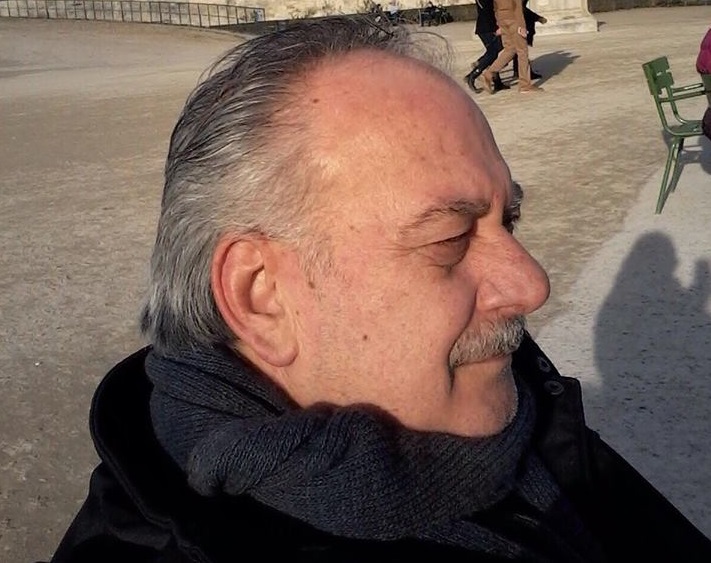
An interview with Dr. Hissam Saad, a known surgeon in Syria who used to have a large medical practice in Damascus. Though he has suffered a lot and lost a lot over the years of revolution and civil war in Syria, he remains optimistic, determined, and looks to the future of the Syrian society with confidence.

Please tell us who you are and what you did before the revolution.
My name is Hissam Saad and I am 60 years old. I am a surgeon who before the revolution ran a medical practice for over 20 years. I am a husband and father of three children; my eldest son, Sarmad, served in the army before the revolution.

What is your religion?
First of all, I am Syrian: this is my both religion and ethnicity. Christianity is my second religion; I am an Orthodox Christian.

Could you tell us about your participation in the Syrian revolution?
50 years ago, the country became a dictatorship; the father of the current… (he pauses, reluctant to say the name) came into power, turning the country into a dictatorship.
When the Arab Spring broke, I, as a surgeon, could not stay away from it, becoming intensively involved in all areas of the revolutionary movement and participating in all rallies. Bashar Assad is a dictator; you probably know that he started shooting at people who gathered for rallies. Though I am a Christian, I went to the mosque where we all gathered before the rallies. All Syrian rallies come out of mosques: a mosque is not only a place of worship but also a meeting venue, a place where people of various religions can get together at a certain time and day; not only it is a place for Muslims or Christians but for all those who want to get together to stand up against a dictator.

My impression is that initially the revolution was a social protest, a fight for human rights and against despotism that at some point turned into a religious warfare deliberately impelled by ethno-religious hatred. Am I right? How did it all actually happen?
Indeed, the revolution was meant to address social and economic issues. But soon, the regime started to plant its agents into protest meetings to switch the agenda to religious issues. Initially, the revolution had nothing to do with religion; all this was done by the regime. By the way, in Syria, not only Muslims but Christians, too, say “Allāhu Akbar”: this is a common expression here, a custom if you like.
2.5 years later, ISIL emerged, as a result of the efforts of the Irani, Iraqui, and Syrian regimes. Initially, ISIL was made up of convicts released from Iraqui and Syrian prisons. Several other countries took a hand in the creation of ISIL, too.
Soon after the revolution started, the Free Syrian Army was formed. At first, its fight against the despotic regime was met with support; over time, however, all of its supporters turned away from the FSA and now the Army gets no support at all.
ISIL was created by command of the Syrian and Iraqui regimes to shift the agenda from social and economic issues and onto religious matters.

Will you tell us about your unique experience, the experience of a surgeon taking part in the revolution? About your son fighting in the army?
Sarmad saw the regime’s troops do terrible things to protesters, shooting and killing them. Two of his army comrades who refused to shoot at protesters were executed at once. Sarmad had always been a free man loathing anger and aggression. When they killed his friends, he and 23 other soldiers left the regime’s army, moving from the southern part of Aleppo to its western part where the Free Syrian Army was stationed.
After Sarmad left the army, the regime’s security service men came to my clinic to break everything there and threaten me. It happened 5 months after my son’s defection. But even after that I continued to work at the clinic, participating, as a free Syrian, in rallies, shooting and posting videos in social networks to let people know what was going on.
On November 23, 2012, I was arrested at the clinic and taken to one of the security service departments, department 255, where they kept me for 7 months. Then they transferred me to department 285. They beat me and tortured me brutally. As a surgeon, I operated in clandestine clinics on those who got shot. 20 days after I was arrested, Sarmad was killed by a sniper. He was killed together with his friend. Sarmad’s photo is my account’s profile picture now.

Dr. Saad, it is very important to document the regime’s crimes. I realize full well that my question may be frustrating for you but I still want you to tell us what happened to you in prison and how they tortured you, both physically and mentally.
They beat me. They beat me with a strap, kicked me with their boots, they beat me with everything they could. They broke my fingers. I am a surgeon and they broke all my fingers. They would lift me by my shoulder and leave me hanging like this for 3 hours. But the worst of all the torture I endured was cold (it was wintertime and I had no clothes on) and hunger: we were starving; they would not let us eat. They tortured me mentally threatening to rape my mother and daughter; they humiliated me as a human being and as a doctor. When they questioned me, I was standing before them stark naked, blindfolded, with my hands tied. It all lasted for 7 months.

Why did they let you go?
7 months later they sent me to a counter-terrorist court to try my case. Seeing that I wasn’t a terrorist, the judge let me go.

Can you still operate?
No, I cannot: my hands do not obey me because my fingers are broken.
And before that happened, you were a successful doctor known in Syria?
Yes, I was.
When did you leave Syria?
We left Syria in mid-June 2013, two weeks after they freed me. The French Ministry of Foreign Affairs sent the visas for my family and me to Beirut.
What do you think is going to happen next? Do you see a way out of all this mess Syria is now in? What do you think should be done?
All this will end if the whole world continues its pressure and starts using all available means to stop the dictator, the murderer.
Even if the regime succeeds in making Syria fall apart into several states, this will mean nothing: we will continue to fight no matter what. We’ll fight for a hundred years if we have to. Syria must be one country.

Do you think the situation in Syria will come back to normal if the regime is overthrown?
Absolutely. After Assad goes, we will start building a new, free Syria: a democratic, multi-ethnic, and multi-confessional country.
