
Roman Burko, founder of the international volunteer intelligence community InformNapalm
Russia’s war against Ukraine is not only a war for territory. It is also a struggle for identity, memory, and people themselves — for the right to define who belongs to which civilization and future.
In a recent interview, British writer and journalist Peter Pomerantsev described collective narcissism as one of the core foundations of Russian society and imperial thinking. That idea struck me as extraordinarily accurate because it closely resonated with my own experience of living in the post-Soviet space of Ukraine’s border regions.
I am speaking primarily about Donbas and Crimea — regions that in the 1990s and 2000s were full of people of Ukrainian origin who had lost or deeply buried their Ukrainian identity while attempting to fit into the Russian imperial paradigm.
In Sevastopol during the 2010s, I used to joke that some locals came across as theatrical and pompous trying so hard to present themselves as “Russian” that at times it seemed they wanted to be even “more Russian” than Russians themselves.
This showed in everyday conversations, ostentatious imperial nostalgia, the cult of Soviet military symbols, and a particular manner of speaking about “greatness” and the “Russian world.”
Similar processes existed in Donbas, where I was born and spent my childhood and youth. There, too, one could observe almost cartoonish displays of “Russianness,” often intertwined with another illusion — a cult of glossy, performative success, frequently associated with short-term work trips to Moscow.
For many, Moscow appeared to be a center of power, money, and status. At the same time, those very people often admitted that it was a territory governed by the “law of the jungle,” where one could go without pay for a month of honest work on a construction site or get mugged by local thugs happy to “pinch a Ukie.”
And here lies the central paradox: despite all attempts to conceal their Ukrainian origin, switch to the Russian language, and assimilate, people from Ukraine were still commonly labeled as “Ukies” inside Russia and treated as a category of “inferior sort.”
People from eastern Ukraine and other regions who moved to Russia could spend years trying to become part of the imperial identity, yet the empire still refused to see them as equal members of the “titular nation.”
This is why the Russian propaganda narrative about “one people,” promoted since the very beginning of Russia’s hybrid aggression in 2014, always appeared fundamentally artificial.
Artificial — because Russia never truly sought equality or brotherhood. Its real goal was to dissolve Ukrainian identity in order to implant its own narratives and cognitively influence the population of the country against which it had been waging a long-term war.
This led me to conclude that many Ukrainians who accepted the rules of this game and attempted to mimic Russian identity were, in fact, subconsciously falling under the influence of imperial narcissism. They themselves became its product — and later reproduced it.
There is an old saying: the worst master is a former slave. Likewise, one of the cruelest servants of the Kremlin’s imperial system is often someone who once belonged to another background or identity but fully embraced the imperial model.
Perhaps this is why among Russian military officers and security officials we so often encounter people with Ukrainian surnames or biographies tied to Ukraine. For example, Russian war criminal and now Major General Sergey Atroshchenko was born in Ovruch, Zhytomyr Oblast of Ukraine, later moved to Russia, and built his military career there. He became one of the officers responsible for ordering the bombing of the Mariupol Drama Theater and the maternity hospital.
Having received education, careers, and social recognition in Russia, they adopted the imperial paradigm and began serving not their roots, but the Kremlin’s interests — sometimes striving to prove their loyalty to Moscow even more zealously than ethnic Russians themselves.
And this pattern applies not only to Ukrainians, but also to representatives of other peoples once subjugated by the empire.
But now another process is unfolding.
The more Ukraine demonstrates its own agency — military, technological, political, and moral — the more people inside Russia begin to emerge from the imperial fog. The myth of Russian “greatness” is beginning to crack.
People are starting to search for another truth, other meanings, other identities, and a connection to their real origins.
Some literally begin digging into their genealogy — through grandparents, archives, old photographs, and documents — trying to understand where exactly their family history lost its point of reference. For some, it is a story of forced resettlements, labor camps, or deportations. For others, it is the story of voluntarily moving to Russia in search of a “better life” that ultimately turned into a trap of imperial assimilation.
This is one reason why the Kremlin today is so nervous about restricting access to the internet, popular messengers, Telegram, independent platforms, and digital services.
This year, Russia adopted legislation prohibiting the transfer of a person’s genetic data to foreign individuals and legal entities for the purpose of “population genetic and/or immunological research.”
In effect, this criminalizes the use by Russian citizens of popular DNA genealogy services such as MyHeritage and FamilyTreeDNA, through which thousands of people around the world discover their ancestry and reconnect with relatives.
Because by communicating with the outside world and exploring themselves, Russian citizens might begin rethinking who they are, rediscovering their roots, and forming new meanings.
And not necessarily in a Ukrainian context. For some, this may involve returning to the identity of small indigenous peoples, regional cultures, or ancestral roots. But for Moscow, any alternative self-identification constitutes a threat, because the empire survives only as long as everyone agrees to see themselves as part of the “great Russian civilization.”
And here, a strategic window of opportunity opens for Ukraine — one that few have yet grasped in its full scale.
The trend of identity transformation inside Russia has not yet become a mass phenomenon. It remains vague, fragmented, and often hidden even from those experiencing it. But it already exists.
It is visible to those who work directly with Russian society — Ukrainian intelligence services, volunteer initiatives, OSINT communities such as InformNapalm, and organizations like Prometheus, which have long worked with ethnic Ukrainians and representatives of other peoples oppressed inside Russia itself.
Over the past years, one thing has become clear: there are people in Russia who formally possess Russian citizenship but internally no longer wish to be part of the imperial model.
Some of them are prepared not merely to sympathize with Ukraine, but to act on its behalf — risking their freedom, status, and sometimes even their lives.
And Ukraine has already begun, intuitively, to explore a new principle: the right to become part of the Ukrainian political nation should be determined not solely by origin or passport, but by personal choice, action, responsibility, and willingness to fight for freedom and justice.
So far, these are only early signs — isolated stories, localized decisions. But perhaps this is where one of Ukraine’s future strategies is beginning to take shape.
Not the concept of the “good Russian” — that model is doomed from the outset because it leaves a person trapped within the imperial framework.
Rather, a fundamentally different approach: the possibility of returning to one’s roots, to the truth about oneself, to the aspiration to become not a “good Russian,” but a genuinely good Ukrainian — through choice, responsibility, and service.
And here Ukraine may, for the first time in centuries, begin acting not as an object of imperial politics but as a subject capable of creating its own model of attraction.
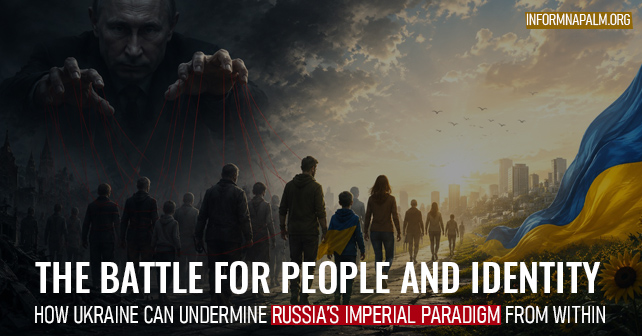
The Battle for People and Identity
For decades, Russia extracted from Ukraine people, talent, resources, identity, and history. It Russified, assimilated, and absorbed.
In recent years, the empire has waged a genuine demographic war against us: exterminating civilians, de-Ukrainianizing occupied territories, and forcing Ukrainian youth to flee abroad in search of safety.
Future generations of Ukrainians are under attack. Children.
In 2023, the International Criminal Court in The Hague issued an arrest warrant for Vladimir Putin precisely over one of the gravest war crimes — the unlawful deportation of Ukrainian children to Russia.
There, these children are being turned into mankurts — people stripped of memory, roots, and identity, who can later be used in future imperial wars.
Putin repeatedly says he is prepared to “fight to the last Ukrainian.” Because his concept of “one people” ultimately means only one thing: that this people must become Russian.
We must acknowledge that the Kremlin’s genocidal policies have already caused catastrophic demographic losses. Compensating for that damage is one of the most pressing and painful problems facing Ukraine today.
Birth rates are not increasing, while the imagined prospect of mass immigration from Bangladesh has turned into another domestic scare narrative amplified by hostile information operations.
But Ukraine now has an opportunity to reverse this negative trend: to stop being a donor of human capital to the empire and become instead a recipient of new citizens willing to break with the imperial past.
And Ukraine can do this not through coercion. Not through child abductions and re-education camps. Not through ethnic hatred.
But by demonstrating a will to live and to win — by embodying success in contrast to a bankrupt empire. By creating a system in which a person can earn the right to belong to the Ukrainian political nation through their own choices and actions.
And this can apply not only to ethnic Ukrainians in Russia. The imperial model rests upon a vast number of suppressed identities — from indigenous peoples to people who simply no longer wish to live in a system built on lies, fear, hatred, and endless war.
Ukraine, by contrast, has the potential to offer another model: not an empire of subjugation, but a political nation of participation. For the first time in centuries, Ukraine may be able to act not as an object of imperial policy, but as a subject capable of attracting people toward an alternative civilizational model.
That is why the struggle against Russia is not merely a struggle for territory. It is a struggle for people, for identity, and for the future civilizational model of the entire region.
Perhaps Ukraine should already be thinking about creating broader and clearer mechanisms of integration for those willing to act in its interests. Not merely to “repent” symbolically, but to genuinely work, take risks, serve, help, fight for Ukraine, and tie their future to it.
A simple rallying cry will not be enough.
We will need to undertake enormous internal work in preparing society to accept people from Russia as fellow citizens. Ukrainian society, traumatized by war, is already experiencing deep internal tensions because of the unequal contributions different categories of citizens make toward victory. And now — inviting people from the enemy’s side as well?
This is a question of social contract and national consensus. If Ukraine fails to build a social contract with anti-imperial former subjects of the Russian Federation, then in the future it may have to build one with culturally far less integrated migrant groups.
There are also more practical problems. Ukraine’s current migration policy is astonishingly counterproductive. A vast number of foreign veterans who fought in our war against Russia have spent years unable to obtain citizenship. There have even been shameful cases of deportations — including directly into the hands of the enemy.
It is time to understand: this is a matter of survival. Bureaucracy must therefore move into the background, making more room for attracting people from other countries into the Ukrainian political nation.
And ethnicity may be only one factor in this process — but not the only criterion. After all, there are already thousands of people inside Ukraine who are married to Russian citizens, have lived in Ukraine for a significant part of their lives, and despite contributing to Ukraine’s defense and future victory, still cannot obtain Ukrainian citizenship because of outdated legislation and bureaucratic barriers. I personally know such stories as well.
States in the twenty-first century compete not only for territory. They compete for people, talent, motivation, meaning, and models of the future.
And if Ukraine learns how to transform the empire’s human capital into its own strength, this could become one of the most effective instruments for dismantling the Russian imperial paradigm from within.
Not only through drones, missiles, or international economic pressure.
But through the destruction of the empire’s central foundation — the belief that being part of Russia is more prestigious, more powerful, and more promising than being oneself.
That is the moment when the empire truly begins to lose.


