We present a new publication from the series Faces of ATO
“… There aren’t too many young people here; however there are many men of my age. Do you know why? We have already lived two thirds of our lives. We came here so the youth would live peacefully in a free country.”
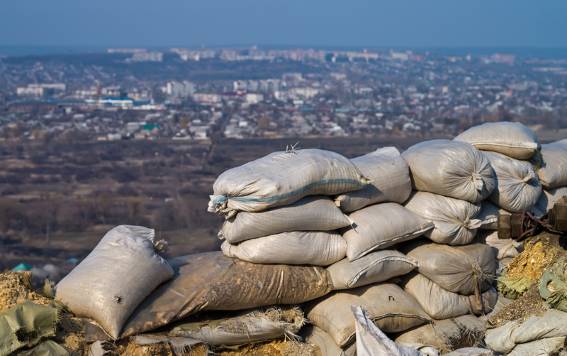
Karachun. This mountain, located on the outskirts of Sloviansk is now well known in Ukraine and beyond. From April through July of 2014, due to the important strategic position of this mountain, fighting between Ukrainian soldiers and pro-Russian terrorists was going on here. In July of 2014, as a result of shelling, supporting cables from a local TV tower got broken and it fell down damaging a nearby building.
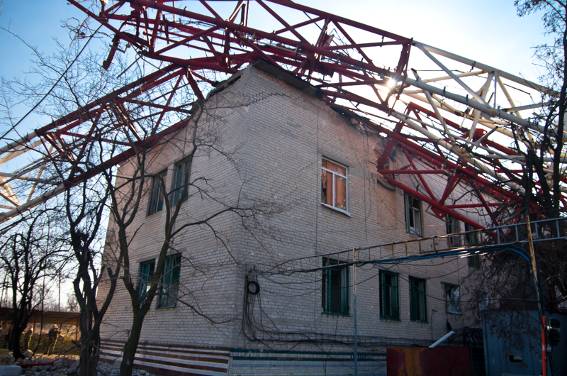
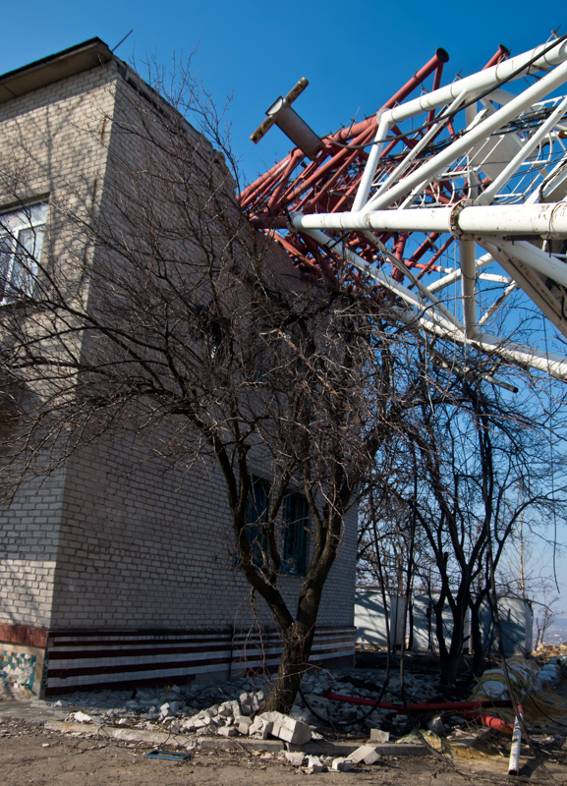
Currently everything remains practically the same as in last July: the fallen tower, trenches, and trench shelters, but a lot has changed too. The most important is the fact that Karachun is ours!
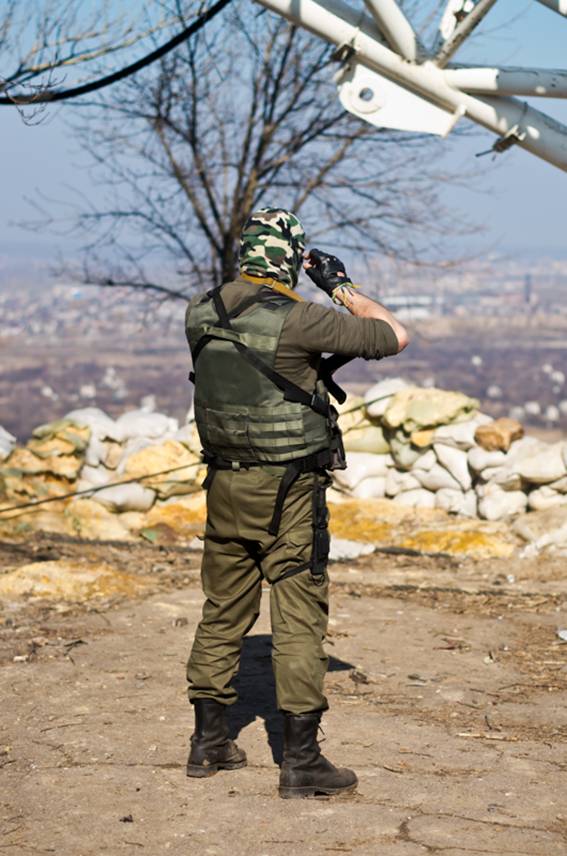
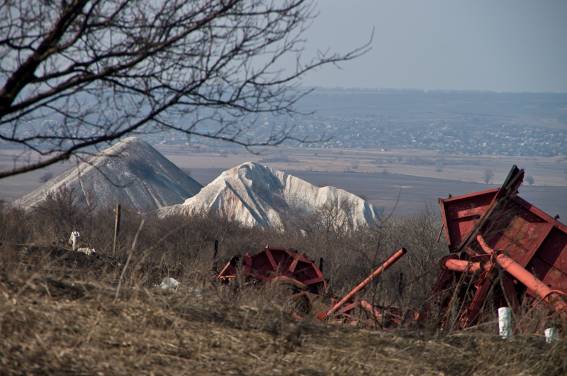
We were walking around the camp accompanied by a young first lieutenant. The National Guard soldiers were carefully digging the ground of the flowerbed near one of the buildings.
“What for?” I blurted out an involuntary question.
“What do you mean what for?” First lieutenant Dima even stopped in surprise. “It’s spring time! The ground has to be tilled. We are going to be here for at least two months. We need to settle down a bit and take care of the grounds…”
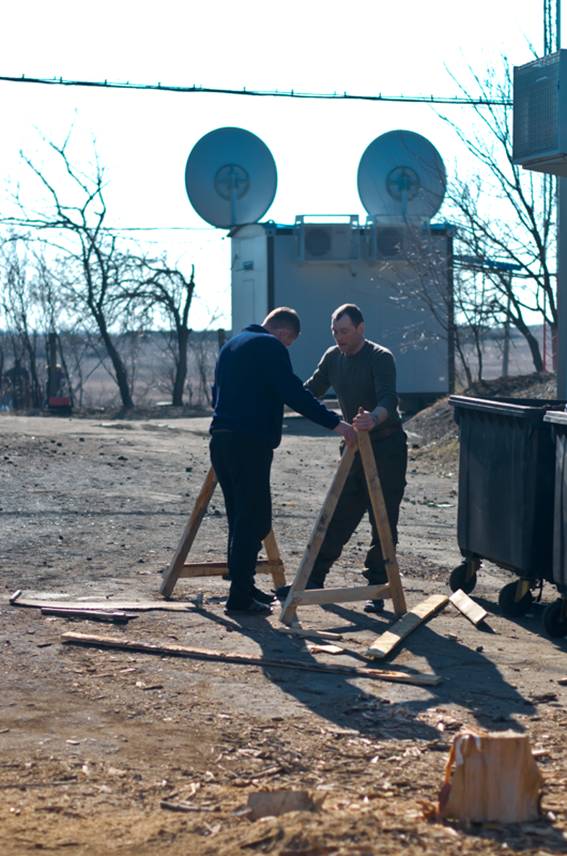
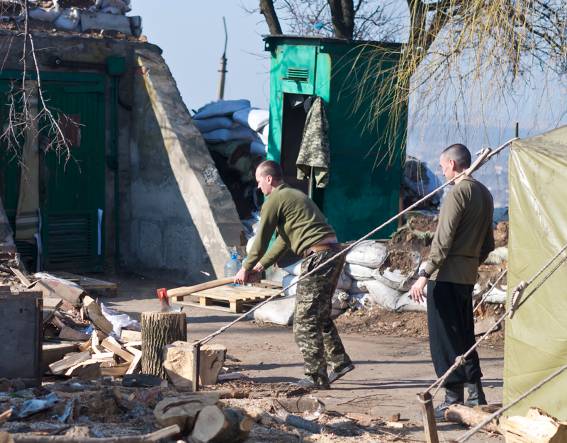
A little further away a few men were carefully constructing something. A saw was cheerfully “singing”, accompanied by sounds of hammering. What for? Half an hour later the answer came up – a wooden rack to clean boots.
“Well, nobody should bring dirt inside,” the guys commented on their handy work.
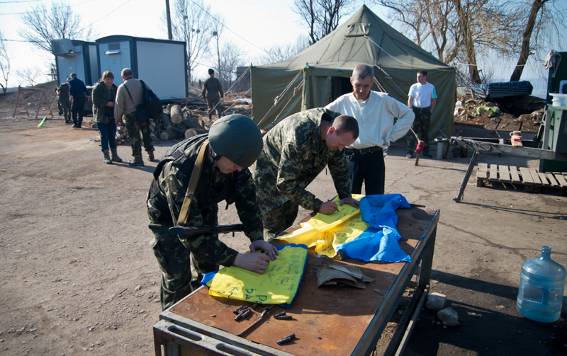
“Dima, have they been in the National Guard for long?”
“No, they came recently. All of them are from the fourth wave of mobilization, practically all of them are volunteers and all are from Kharkiv!”
The age range struck the eye: the youth and those over 45 years old.
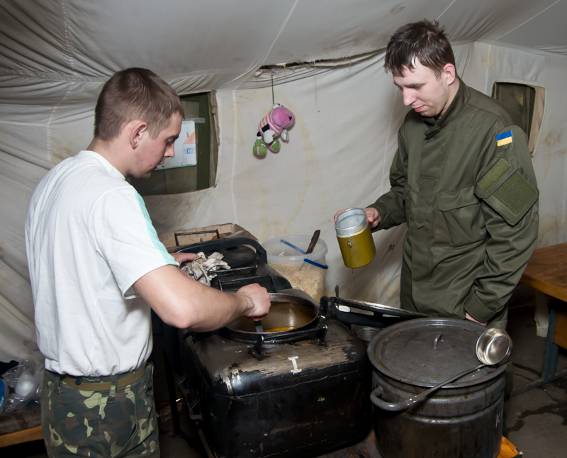
A lean man was “doing magic” over the field kitchen.
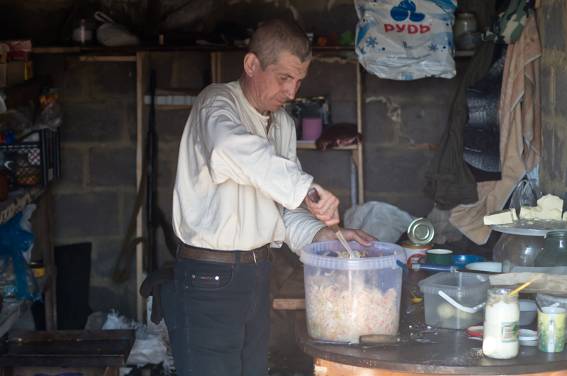
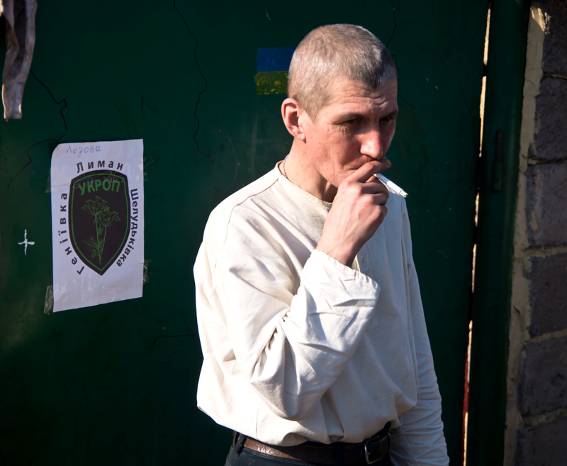
Igor Kostyuchenko is almost 47. Before the war, he worked as a grinder at factories in Kharkiv. His family that now lives in Lozova, had no idea about Igor’s decision to go to war as a volunteer until recently.
“I have passed the service age, but I understood that I had to be here. There is an undeclared war here. That’s my own decision: I turned to the military commissariat and asked to reinstate my draft registration. I was enlisted as a rifleman/radio communications specialist.”
“As a rifleman? How come you are at the kitchen stove? And now what is more important for your companions: your shooting skills or chef talents?”
“I guess the latter. I have been feeling some thirst for cooking since childhood. I like cooking tasty food and enjoy eating tasty meals. That’s why I do my best to provide the guys with homemade food.”
“Have you been successful?”
“I guess you should ask the guys this question”, said Igor with a smile. “But we really work hard with my companion preparing field-made soups, pickle soups, bean soups, and surely authentic Ukrainian borscht. Doing our best to diversify the menu based on the available ingredients. I have to confess that we cook lots of stuff but we cannot prepare fried potatoes, we are just lacking an appropriate pan. Though, we hope that volunteers will help.”
“Do they help?”
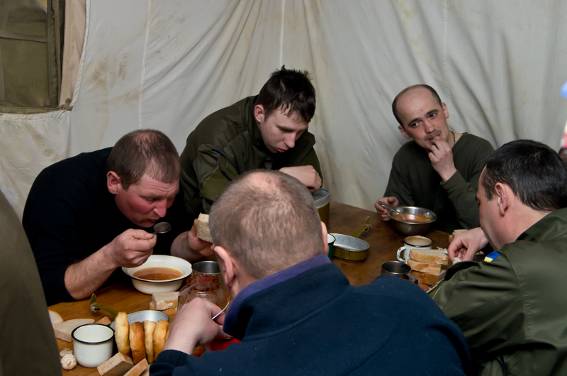
“Yes and we are really grateful to them for that! You know what? Thanks to volunteers, we feel the whole country is standing behind us and trusts us. Believe me, it is very important for us here! We really want this war to be over soon. And then, look: there aren’t too many young people here; however there are many men of my age. Do you know why? We have already lived two thirds of our lives. We came here so the youth would live peacefully in a free country. Believe me we will be staying here for as long as it’s necessary for the sake of our families and children!”
His bearded comrade-in-arms with the call sign “Dikiy” immediately supports him.
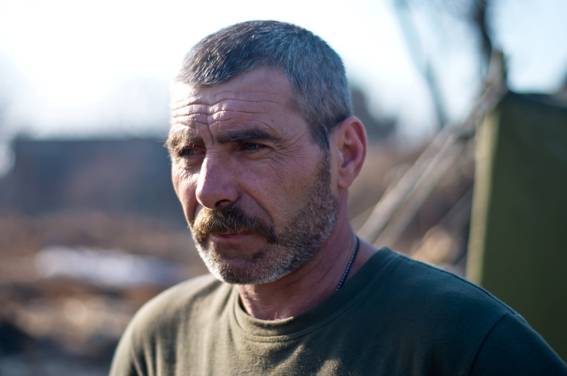
“I am 48 years old, I have two sons. One studies at the Military Infantry Academy in Odesa, the second one joined the military to defend our country as a volunteer.
“I am a professional soldier, my previous life before retirement was related to the army and air force. I cannot stand aside these days, I cannot feel comfortable sitting out in the rear while my sons are fighting for their land at the front.
“I feel better here, this way I am boiling in the same pot with my sons. You have to understand that after our victory and later on, say 5–10 years later, I don’t want to be ashamed looking into the eyes of my children, grandchildren, and friends. That’s why I went to the military commissariat and demanded to be accepted as a volunteer.”
“And how did your children and your wife react to your decision to join the Ukrainian National Guard as a volunteer?”
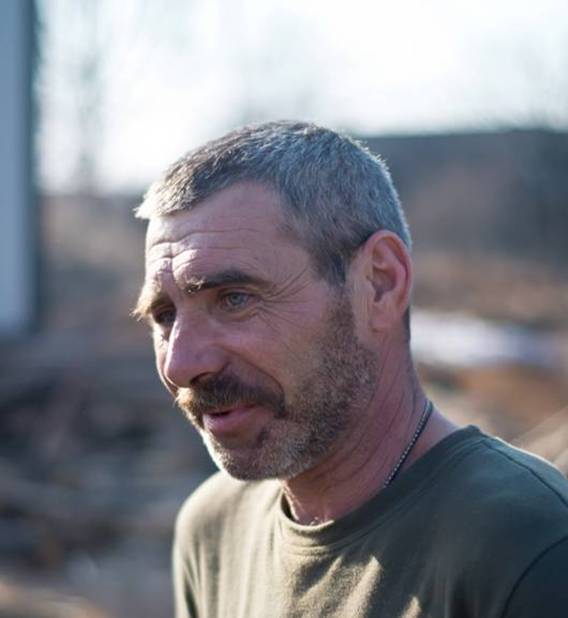
“You know, I’ve always taught my sons to love and respect their homeland. Ukraine is our homeland. As a professional soldier, I can responsibly tell you that now we are engaged in a real war. It’s time for everybody to understand and accept that our enemy is Russia. That’s the reality.
“We did not start this war. Do not believe those who say that the battles here are against some mythical pro-Russian citizens of Donbas. We are fighting against a well-trained Russian army. I understand it, my sons and wife whose life has always been connected with our army, understand it too. That’s why they supported my decision to stand up and defend Ukraine. Of course, she is afraid for the children and me the same as any other woman. However, she understands that if we do not go there to defend our country, the enemy will burst into our house in Kharkiv.”
We have to admit that until now we rarely met people in military uniform who would admit that they went to war to spare their children of “the military fate”.
“They are from Kharkiv. That says it all!” the first lieutenant commented on our thoughts and added: “Let’s go meet another volunteer. The man’s got grandchildren though he can teach a thing or two to any youth.”
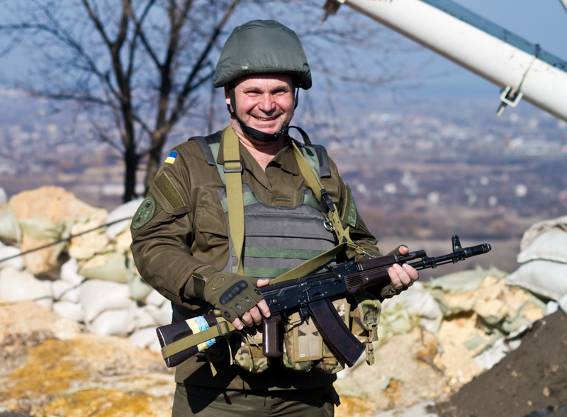
Sergeant Major Sergey Brazhnik, 57 years old, is from the town of Komsomolske of Zmiiv Raion, Kharkiv Oblast. He served as a conscript 38 years ago in the Southern military forces. Before the war, he had his own quite profitable business. Here, in the National Guard, he is respectfully called by his name and patronymic name – Sergey Vasilyevich. The story of how he was “taken off the train and sent to the National Guard” has become legendary.
“Yeah, it’s a story. I wanted to join a volunteer battalion for quite a while but my wife hid my ID and military service card, so I couldn’t find them for two months. I felt very emotional over my wife’s inability to understand my decision to join the army as a volunteer. That’s why I went to the military commissariat and asked them to give me a draft notice for mobilization – basically for my wife, as proof that I didn’t sign up myself but was conscripted,” the sergeant said with a smile and then continued: “My son-in-law is also anxious to volunteer, but I told him: ‘You are young, take care of your family, let me go and defend you and the country.’”
“Why did you make this decision?”
“I’s hard for me to explain it in two words. Why? Because I am a Ukrainian, Ukraine is my country. Russia has invaded my homeland. I am a man and I have to defend my family, my friends, and my country!”
“However we are not speaking with you in Ukrainian but in Russian …”
“Anyways we don’t feel as Russians and we don’t say that our home is Russia. So, what language we speak in our home is our own business, not Russia’s. By the way, I am fluent in Ukrainian and, I guess, so you are!” he said in Ukrainian.
“What do you think is currently going on here in Donbas? How would you call it?”
“I am sure that this a war against Russia. The Anti Terrorists Operation was over a few months after it had started,” he responded in Ukrainian.
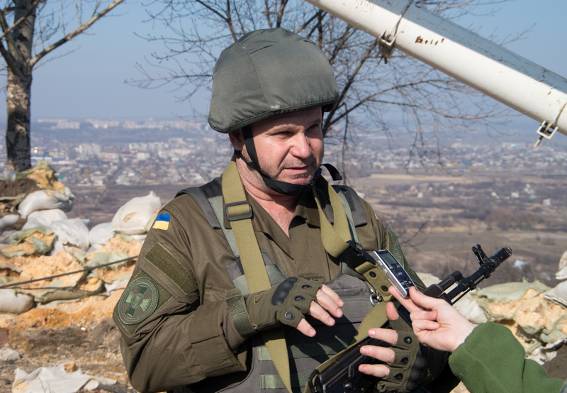
“Now let me say something in Russian just in case someone in that country may hear. What we have going on in eastern Ukraine is not even the war against Russian aggression, but rather our civilizational choice. They want us to live in their world according to their laws, but we have chosen our own way, an entirely different civilized world. We have to struggle and fight for this option. It’s okay! Fight and you will overcome!”
“Sergey, how do you manage to build communication with your companions in arms? In fact some of them are your children’s age, including officers. Don’t you sometimes have an urge to teach them in a fatherly way, to make a remark or give advice?”
“Honestly speaking, I do, but only in a “fatherly way”. Besides, I used to work in senior positions and that’s left its trace on my character. It’s alright, I am changing myself along with my attitude towards my comrades-in-arms. We are all equal here!”
Our conversation with the sergeant was closely watched by a young guy.
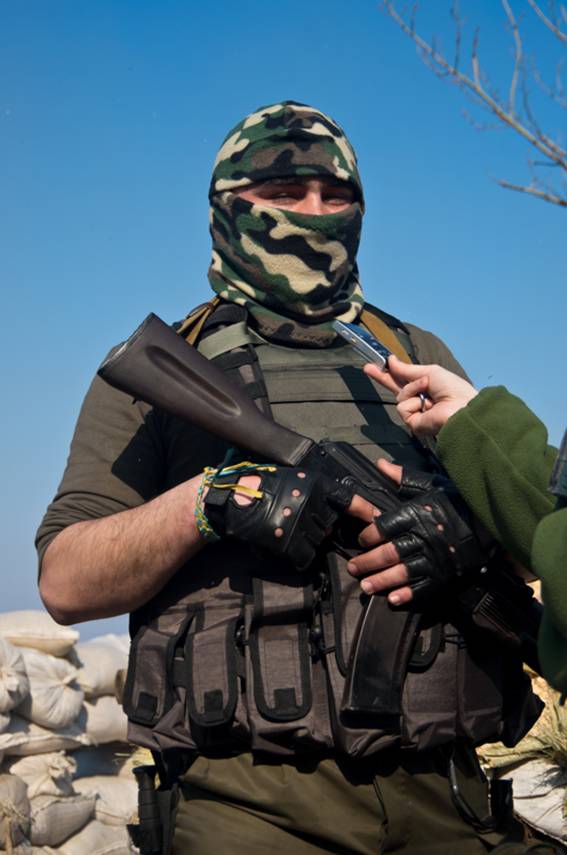
“Dima, the youth also joins the army in the course of mobilization!” we said pointing at the guy.
“That is true. He is an officer and a platoon commander.”
His call sign is “Tur”. He is from Kharkiv, a graduate of the Railway Transportation Academy. He got his military training through a college military Reserve program. It’s a known fact that many reserve officers refused to go to war because of the lack of necessary knowledge and skills. Tur disagrees with such reasoning. He says that the most important thing is the desire to defend our country; you can learn anything if you want to.
“I got into the National Guard during the last wave of mobilization. When I got a draft notice, I immediately went to the commissariat and passed the health test. I’ve been in the service since February 10. I didn’t have any doubts whatsoever about the need to defend the country! As for some lack of knowledge and certain skills, you may agree that, as in any job, there is always chance for improvement and learning something new on the way of becoming an expert. The same happens here: the needed skills can be built up quite fast.”
“How do you manage to command the soldiers who are old enough to be your fathers? Is it difficult?”
“I wouldn’t say so,” said our hero with a smile. “If you are one team, one integrated unit, everything is going to be all right. I myself have learned a lot from my soldiers.”
“What supports your personal confidence in the victory?”
“Realization that I am here for my family and my country. I have a little daughter, and am expecting to have a son soon. If my friends and I leave, what would happen to my hometown tomorrow? Please understand that we do not cast the slightest thought of retreating! We are determined to go forward, all the way to the victory!”
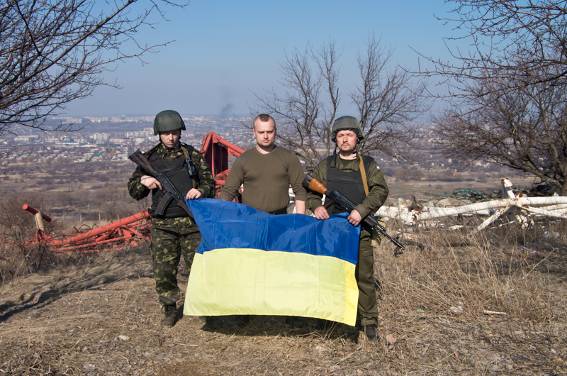
So here they are, Kharkiv natives, serving in the unit that celebrated its 95th anniversary on March 11. I wonder if the soldiers themselves know about it.
“Of course we know! We congratulate all our brother soldiers. We are together and we will win!” was their response.
Also, they asked us to bring a photo of them to Kharkiv, for here, on the outskirts of Sloviansk, having served in the National Guard for less than a month, they feel as an inalienable part of the family with a long and heroic history.
Translated by Roman Vlasov
Edited by Sveta Kemblowski
Original article: http://mvs.gov.ua/mvs/control/main/uk/publish/article/1394061