
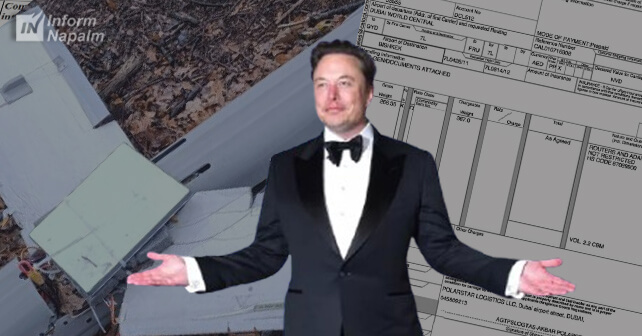
Growing problem: Starlink on Russian drones
As early as 2024, Russia began experimentally installing Starlink terminals on its reconnaissance and attack drones to evade Ukrainian electronic warfare (EW) systems. By late 2025 – early 2026, this had already developed into a systemic practice directly impacting the effectiveness of Russian terrorist strikes on civilian infrastructure.
Starlink satellite channel provides drones with:
- stable control under active jamming and spoofing;
- real-time data transmission;
- increased range and accuracy of terrorist attacks.
In effect, Starlink has become a technological multiplier of the combat capabilities for the Russian drone units.
Documented use of Starlink on Russian UAVs:
- Shahed / Geran are long-range kamikaze drones (up to 2,000 km); Starlink terminals were recorded on downed UAVs in 2024-2026.
- Molniya (Molniya-2, Molniya-2R) are tactical FPV drones (with a range of up to 50-60 km) adapted for reconnaissance and strike missions, some of them equipped with Starlink Mini; since December 2025, they have been actively used by the Russian Rubicon unit.
- BM-35 is a long-range drone (up to 500 km) with documented Starlink use in January 2026 during strikes on the Dnipro and Odessa.
Western and Ukrainian investigations, in particular findings of Der Spiegel that were confirmed the Main Intelligence Directorate of the Ministry of Defense of Ukraine, as well as analyses by Defense Express, ISW, and electronic warfare expert Sergiy Beskrestnov, indicate that Russia is deliberately scaling up its use of Starlink to counter Ukrainian electronic warfare systems.
How Starlink enters Russia: routes, sanctions-bypassing logic, and terminal accumulation
Despite sanctions and SpaceX’s public statements about the absence of deliveries to Russia, Starlink terminals are being supplied through parallel import schemes and third countries.
OSINT research by Nordsint, which we highlighted in early January 2026, showed that such schemes include the following:
- routing the supplies through countries of the Middle East, Central and East Asia as transit hubs;
- activation of terminals through accounts registered outside the Russian Federation;
- legalization of equipment through fictitious or forged declarations.
Nordsint, the author of the study, also provided InformNapalm volunteer intelligence community with a copy of the air waybill, which they received from Emaross Group FZE in response to their request.
The document confirms the shipment of a consignment of equipment from Dubai World Central (UAE) to Bishkek (Kyrgyzstan) in May 2024—a route that has been repeatedly spotted in re-export schemes to Russia.


There is familiar detail—they deliberately manipulate customs classification of the goods: on the invoice, Starlink equipment is declared as “routers and adapters”, with HS code 87089900, which corresponds to auto parts, not telecommunications equipment. This practice is widely used avoid unwelcome attention from the customs and regulatory authorities when transporting sensitive technology.
Taken together, these facts point not to isolated violations, but to the accumulation of Starlink shipments, which are subsequently delivered to Russia and used for military purposes to wage an aggressive terrorist war against Ukraine.
Conclusions and possible response measures
The findings indicate that the issue of Starlink supplies to Russia extends beyond the formal sanctions regime and has direct military implications for Ukraine, particularly in the humanitarian sphere. Russian drone attacks are aimed primarily at harming the country’s civilian population—cutting off electricity, water, and heat during the cold winter months.
Possible response for the global community:
- Strengthen export and transit controls over the supply of satellite and telecommunications equipment to countries that are systematically used as re-export hubs to the Russian Federation;
- Analyze the traffic and identify of Starlink terminals delivered to such countries, followed by an audit of their actual use;
- SpaceX should take technical and administrative measures to restrict or block terminals that are used by Russia for military purposes or that violate sanctions;
- Coordination between sanctions authorities, customs services and manufacturers to identify cargo disguise schemes (in particular, through manipulation of HS codes).
Starlink has long ceased to be a neutral civilian technology. Its use on Russian drones makes the issue of monitoring supplies to the Russian Federation an element of security and protection of the civilian population from Russian terrorist attacks.
UPD: Russian drone attack on Ukrainian civilian train

This article was published on the afternoon of January 27 in Ukrainian. A few hours after the publication, it became known that Russian attack drones attacked civilian train No. 47/103 Barvenkovo-Chop, which was carrying 291 passengers. The Russian Armed Forces launched three Shahed attack drones, which caught up with the train near the village of Yazykovo (77 km from the front line). One UAV hit the rails in front of the locomotive, while others hit a passenger car in the middle of the train. This was not an accident, but a coordinated terrorist attack. The UAV operators clearly saw in real time that they attacked train cars containing civilians. According to Focus magazine, radio technology expert and advisor to the Minister of Defense Sergiy “Flash” Beskrestnov wrote that the Shaheds that attacked the train were equipped with the Starlink satellite communications system.
Focus also noted that as early as the evening of January 27, Polish Foreign Minister Radosław Sikorski publicly appealed to Elon Musk to restrict the Russian military’s use of Starlink. In response, the American billionaire cursed under Sikorsky’s tweet in his characteristic manner and refused to take any action.
Let us remember that SpaceX has the technical means to shut down its terminals selectively. In September 2023, media reports surfaced that Elon Musk secretly ordered the shutdown of Starlink satellite communications in the area of temporarily occupied Crimea in 2022 in order to disrupt a Ukrainian operation to attack Black Sea Fleet ships in the bays of temporarily occupied Sevastopol with surface drones.
Elon Musk may change his mind under pressure from the American public, but this would require a large-scale international response. Dozens, if not hundreds, of publications in influential media outlets have highlighted the problem of using Starlink technology on Russian drones, which poses global terrorist threats to the security of not only civilians in Ukraine but also people in other countries around the world.
Read more:
- OKBMLeaks: classified documents from a Russian components manufacturer for Su-57 fighter and PAK DA Poslannik next-gen bomber
- Budapest as a hub for the Russian defense industry: Hungary facilitating dodging of international sanctions against Russia


