
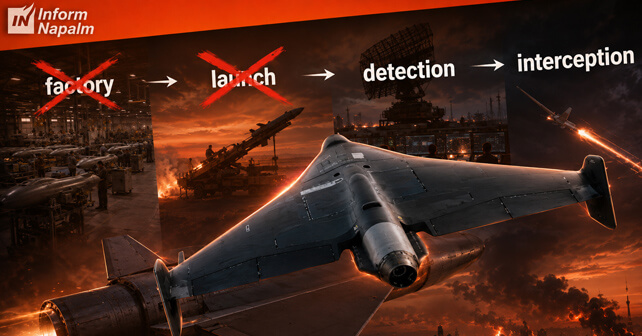
Russian attack drones are becoming faster, more autonomous, and more resilient to countermeasures. Ukraine’s experience shows that the future of air defense will be determined not only by interceptors, but also by situational awareness, the shortest possible kill chain, and the ability to destroy enemy’s strike capabilities before they are launched. For Europe, this is no longer a theoretical problem.
The war in Ukraine demonstrates a simple technological pattern: when a particular countermeasure becomes sufficiently effective, the enemy changes the threat itself.
This is exactly what is happening with Russian attack drones.
Over the past few years, Ukraine has built a multilayered system to counter piston-engine kamikaze drones such as the Shahed-136/Geran-2: surface-to-air missile systems, mobile fire teams, electronic warfare, aviation, and an increasingly large fleet of interceptor drones. Russia responded with moving to the next technological cycle.
Ukraine’s Main Intelligence Directorate of the Ministry of Defense (HUR) directly describes the jet-powered Geran-4 as a response to the growing effectiveness of Ukrainian interceptor drones. With this new drone, Russia has moved beyond simply installing a jet engine in an old airframe and developed a design specifically adapted to much higher speeds.
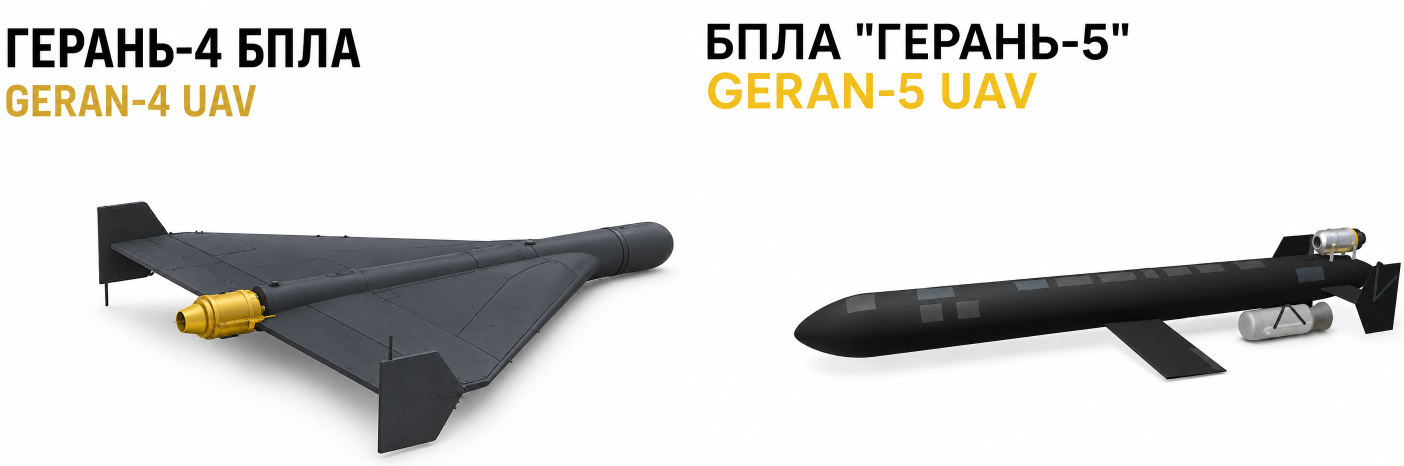
The evolution of Russian attack UAVs: increasing speed, warhead weight, and navigation resilience. Interactive models of the Russian Geran-4 and Geran-5 drones in HUR/War&Sanctions materials.
And the Geran-5, which Russia has already used against Ukraine, shows the direction of further evolution: a cruising speed of 450–600 km/h, a warhead of about 90 kg, a range of up to 950 km, and an operating altitude of up to 6 km. Its design features jamming-resistant satellite navigation, a telemetry transmission system, and a mesh modem.
The line between a kamikaze drone and a relatively inexpensive cruise missile is gradually becoming blurred.
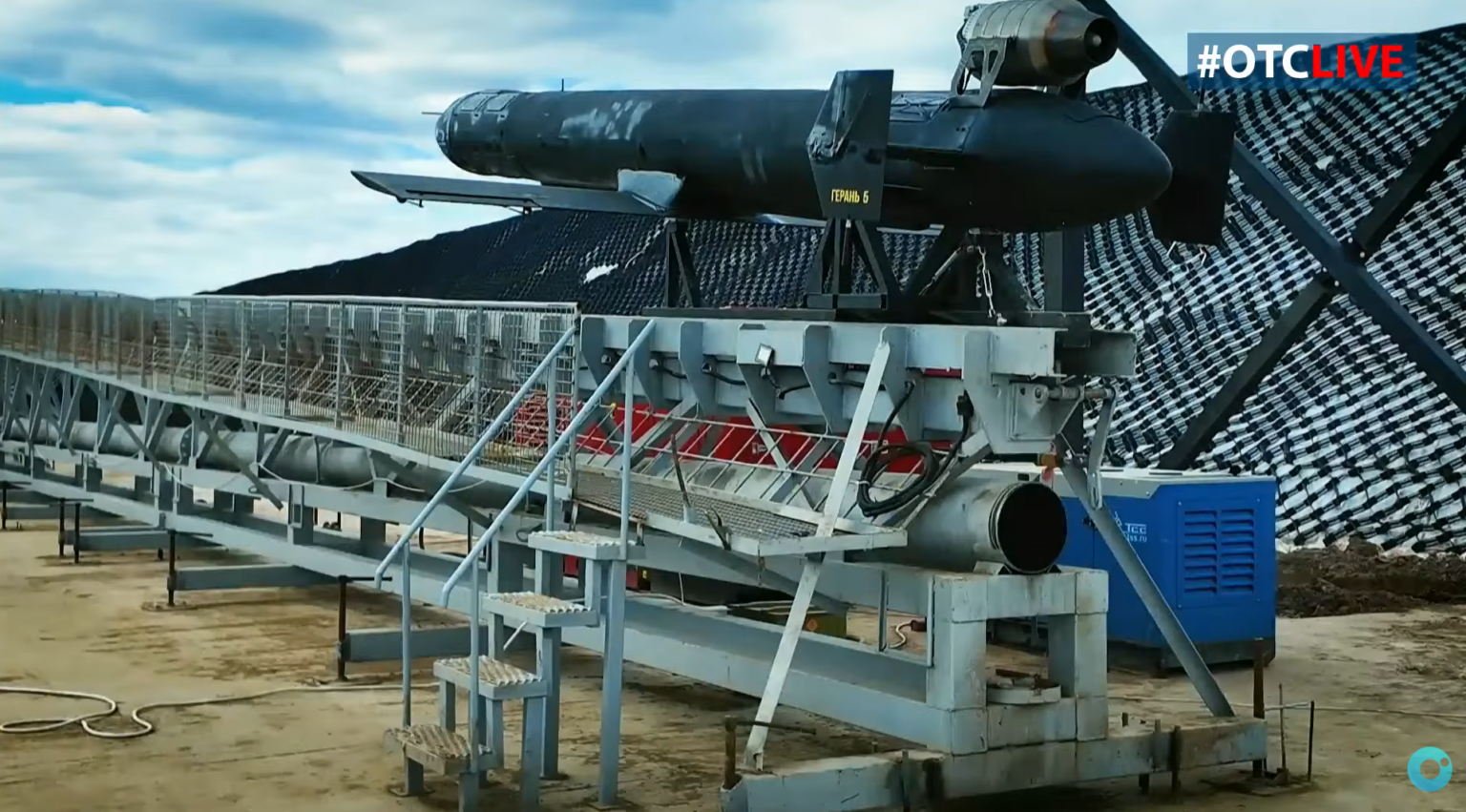
Russian jet-powered Geran-5 attack drone. May 9, 2026. Source: OTC LIVE / Militarnyi.com
It is no longer enough for Europe to prepare for the Shahed-136 / Geran-2 threat of 2023.
The biggest mistake Europe could make now would be to prepare for the Russian tactics Ukraine faced two or three years ago — or even those it is facing today.
The traditional military procurement cycle lasts for years. The adaptation cycle for unmanned systems on the Ukrainian battlefield is sometimes measured in months.
Therefore, a system that appears optimal today against a slow drone may already be designed for a previous generation of the threat by the time it is widely deployed.
In 2026 and 2027, planning should focus not on a specific Geran-4 or Geran-5, but on the development trajectory of Russian weapons:
- higher speed, greater flight altitude, and heavier warheads;
- more autonomous navigation and target recognition;
- greater resilience to electronic warfare and the loss of satellite signals;
- networked and combined use of different UAVs, decoys, and missiles within a single strike package;
- reducing the time between target detection and engagement on both sides.
Not every future system will have all of these characteristics at the same time. However, the direction of development itself is what matters.
Time becomes the main resource of air defense
Being able to shoot down a fast-moving target is not enough. First, you have to see it in time.
The faster an attacking weapon moves, the more costly every second lost between detection and interceptor launch becomes.
Therefore, the key concept for future air defense is the kill chain — “detection → classification → decision → target acquisition → destruction.”
And that chain needs to be shortened constantly.
This is not just about radars. What is needed is a unified system that combines radar, optical, acoustic, aviation, satellite, and other sensors; automatically fuses and compares the information; identifies threats; and passes targeting data to the interceptor that can engage the target most quickly and cost-effectively.
This also means increasing automation. Humans will remain critical decision-makers, but they should not have to manually perform operations that a machine can complete in a split second.
Ukraine is already living through this technological transition.
NATO has a much stronger starting position: the Alliance has significantly greater capabilities in satellite, aerial, and signals intelligence, AWACS, modern combat aircraft, and communications infrastructure.
The problem may therefore not be a lack of information. More likely, it is the speed at which information is turned into action.
The best interceptor is the one that was never needed because the enemy’s weapon never launched
Even a highly effective air defense system remains fundamentally reactive: it comes into action after the enemy has manufactured the weapon, delivered it to the launch area, prepared it for use, and launched it.
In the case of mass attacks, this creates an economic problem.
The defender must detect and intercept hundreds or thousands of individual targets. The attacker, by contrast, only needs to maintain mass production and continually find cheaper ways to overwhelm the defense.
Therefore, the fight against the air threat cannot end with air defense.
It must also include capabilities such as deep precision strike and counterforce — the ability to disrupt or destroy the military system that enables the attack itself: weapons production, warehouses, launch and support infrastructure, military logistics, command nodes, and combat crews.
NATO already effectively recognizes this logic. At the official level, the Alliance notes that the rapidly growing threat of long-range strikes requires not only effective air and missile defense, but also deep precision-strike capabilities that increase the cost of aggression for an adversary. In 2026, the Allies launched several multinational projects to develop ground-based long-range precision-guided systems and long-range strike drones.
This is a fundamental paradigm shift.
One interceptor normally solves the problem of one target.
Striking a well-placed military node may prevent an entire portion of the next strike wave from ever forming.
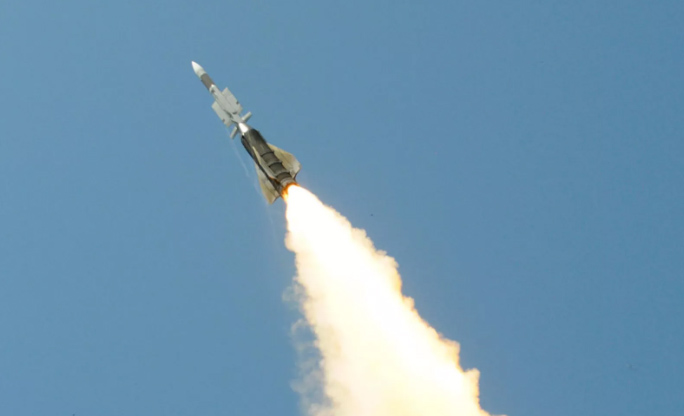
“Russia’s war of aggression against Ukraine has clearly shown that the threat of long-range strikes is growing and evolving fast. These threats necessitate the development of not only effective air and missile defence capabilities, but also of deep precision strike capabilities to deter aggression, raising the costs of attacks by potential adversaries.” Source: NATO – Multinational Capability Cooperation .
Russia has long been applying a “Left of Launch” logic against Europe
Interestingly, Russia began applying a “Left of Launch” logic against European defense potential much earlier: seeking to disrupt or defeat enemy offensive capabilities, including missiles and drones, before they are launched.
On the night of 31 August 2026, a fire broke out at the WB Electronics plant in the Polish city of Skarżysko-Kamienna (Świętokrzyskie Voivodeship), one of Poland’s largest manufacturers of defense and unmanned systems. The incident raised serious concerns because the company produces components for drones, specifically FlyEye and Warmate.
#Russia has long been waging #war against #Europe. And it is operating according to the logic of Left of Launch — seeking to strike defense production before the weapons can even be deployed. https://t.co/FhrkLh4Sy8
— InformNapalm (@InformNapalm) September 1, 2026
Polish prosecutors established that the fire had been deliberately started using a device containing flammable materials. The investigation is being conducted on suspicion of foreign intelligence activity and terrorism. At the time of publication, Russian involvement in this particular incident had not been officially established.
However, other elements of Russia’s sabotage campaign in Europe are already being documented much more convincingly. In March, Eurojust, the European Union Agency for Criminal Justice Cooperation, reported that 22 individuals in Lithuania and Poland were suspected of working for Russian military intelligence in connection with a case involving spontaneously combustible parcels that caused fires at logistics centers in Germany, Poland, and the United Kingdom.
The logic is obvious.
Moscow is seeking to affect not only weapons already on the battlefield, but also the factories, logistics networks, and infrastructure that enable NATO armed forces to obtain those weapons.
And this should be a signal to Europe.
Ukraine is already Europe’s forward defense
For NATO, the way out of the potential political impasse is already there.
It should not wait until the risk of direct Russian aggression against the Baltic states, Poland, or another Alliance member turns into a real crisis.
European governments should not wait until they are forced to strike Russian military infrastructure only after Russian missiles and drones begin arriving in massed attacks on NATO cities.
Part of this task can be accomplished today by strengthening Ukraine’s deep-strike capabilities.
Ukraine is waging war against the very military-industrial system that, in a future confrontation, would produce missiles, attack UAVs, and other weapons for use against NATO.
Therefore, supporting Ukraine’s deep-strike capabilities is not only about helping Ukraine.
It is also Europe’s forward defense.
A Russian missile or drone destroyed at a military depot before launch no longer needs to be intercepted by air defense systems over Kyiv or other Ukrainian cities — or over the EU, for that matter. Nor can it be stockpiled for a future war.
Disabled military production capacity forces Russia to spend time and resources restoring it instead of building up its stockpiles.
A disrupted strike operation means dozens or hundreds of targets that will never appear in the air.
This is where economics, technology, and strategy converge.
Building an increasingly expensive air defense system whose main task is to endlessly intercept every new Russian “arrow” is not enough.
The enemy’s ability to produce, stockpile, launch, and control those arrows must be reduced at the same time.
Russia already understands this principle and is trying to act against European defense potential even before an open war begins.
Europe should draw the same strategic conclusion
Ukraine is already paying a high price for this experience and is constantly adapting to new challenges.
So the key question for NATO is this: shouldn’t it prepare for a future war by drawing on Ukrainian experience, which NATO’s military planners are absorbing more slowly than technological cycles are changing? Isn’t it time to acknowledge that Russia is already waging an active war not only against Ukraine, but is increasingly applying its own “Left of Launch” logic in Europe — seeking to attack production, logistics, and infrastructure before weapons even reach the battlefield?
Within this logic, questions such as access to Starlink satellite communications for Ukrainian long-range UAVs operating over Russian territory, the transfer of longer-range weapons to Ukraine, and the lifting of political restrictions on strikes against Russian military infrastructure are no longer minor policy discussions.
These are decisions that should have been made yesterday.
Because it is much cheaper and safer to destroy launchers, warehouses, command centers, and missile and drone production facilities — including production and development centers such as Alabuga — before hundreds or thousands of these weapons take to the air.
And it is precisely the decisions made today that could determine whether, tomorrow, the Baltic states, Poland, and other nations on NATO’s eastern flank will have to learn the same lessons for which Ukraine has already paid a terrible price.
Read more related material from InformNapalm
- Path of Fire: InformNapalm’s Twelve-Year War Against the Kremlin
- Ukrainian hackers uncover how Russian drone operators are using Belarus
- OKBMLeaks: classified documents from a Russian components manufacturer for Su-57 fighter and PAK DA Poslannik next-gen bomber
- CYBINT operation against the Gonets satellite system, dubbed “Russia’s equivalent of Starlink”
- Wildberries caught in the crossfire of drone strikes and cyber operations
- Ten years later: from OSINT detection to target destruction. Ukrainian Navy hits Russian Bastion missile system in temporarily occupied Crimea
- Hacktivists uncovered new classified documents from STC, Russian manufacturer of Orlan-10 drones
- CYBINT. Hacking Russian UAV manufacturer. Part 1: who assembles Geran-2?
- AlabugaLeaks. Part 2: Kaspersky Lab and neural networks for Russian military drones
- AlabugaLeaks. Part 3: Albatross, war, NVIDIA, Sony and Saito


