
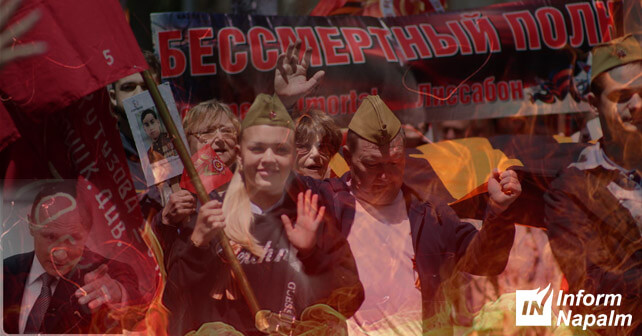
Today, “Victory Day” exposes a painful contradiction. How can a member state of the European Union, one that not only champions democracy, humanism and the defence of liberty, but is founded upon those very principles, continue to tolerate communities within its own society that openly support Russian aggression and espouse the ideology of the “Russkiy Mir”?
In Portugal, there are still numerous Russian and pro-Russian groups, supporters of Putin who justify the war, spread Kremlin propaganda, and even criticise Portuguese citizens for standing with Ukraine. This is not a matter of “having a different opinion”, nor is it about freedom of speech or expression. It is about the tolerance of an ideology that has brought death, occupation and suffering to millions of Ukrainians.
InformNapalm volunteers have previously drawn attention to the activities of the Moscow Patriarchate in Portugal, including the granting of permission to acquire a substantial plot of land in one of Lisbon’s most prestigious coastal areas. Yet the activities of Kremlin and pro-Kremlin propagandists extend far beyond this. On 1 May, for instance, the Soviet Union’s anthem echoed through the streets of Lisbon.

A lingering attachment to Soviet culture and to the Stalinist regime that destroyed millions of lives raises an uncomfortable question: what does it truly reflect? Political blindness, naivety, or a sympathy for authoritarian ideas? In many respects, these are rhetorical questions.
The Militarisation of Memory: “Pobedobesie” as Ideological Distortion
The civilised world has already come to recognise the concept of “pobedobesie” (Russian: победобесие). This derogatory term describes the near-cult-like obsession surrounding “Victory Day” in contemporary Russia; a cult of death and of sacrificing one’s sons to the Kremlin regime, accompanied by a sense of pride in doing so.
It signifies the aggressive militarisation of the memory of the Second World War, the transformation of tragedy and commemoration of the dead into instruments of state propaganda, as well as the promotion of a “we can do it again” mentality, celebrating military power and imperial grandeur.
*Author’s remark
“Pobedobesie” (Russian: победобесие) is a derogatory term used to criticise the way Victory Day is commemorated in contemporary Russia, particularly when it becomes a form of state-driven militarism and ideological spectacle rather than solemn remembrance.
The word is a blend of two Russian elements: pobeda (победа) – meaning “victory”. This refers to the Soviet victory in the Second World War (known in Russia as the “Great Patriotic War”), which remains a central pillar of national identity and public commemoration;
besie (бесие) – derived from bes (бес), meaning a demon, evil spirit, or malevolent force.
In Russian Orthodox tradition, “bes” denotes a demonic or malevolent entity. The suffix -besiye (-бесие) conveys a state of frenzy, obsession, or collective madness, akin to possession or manic exaltation.

Russia’s War Widows: A March of Grief and Propaganda
Russia has increasingly drawn on the Allied victory of 1945 to legitimise its present-day aggression against neighbouring states, including Moldova, Georgia, and now Ukraine. In doing so, it promotes the notion that it possesses a “special entitlement” to the use of force by virtue of the Soviet Union’s role in the Second World War. Within Russia itself, the memory of the war is no longer framed primarily as mourning or commemoration of the fallen. Instead, it has been recast as an instrument of political messaging, a vehicle for militarism, state ideology, and the construction of national myth.
Moreover, the slogan “we can do it again” (“можем повторить”) has taken on a meaning that reflects what many analysts describe as Russia’s increasingly authoritarian and militarised state ideology. It is no longer framed in terms of defence or liberation, but rather of aggression and occupation. In this interpretation, 9 May is no longer simply about commemorating the “grandfathers who fought”, but has become increasingly associated with Russian soldiers killed in the war against Ukraine.
With regard to Russia’s 9 May, noting that much of the civilised world commemorates Victory in Europe Day on 8 May, the occasion has long ceased to function solely as a day of remembrance for those who fought against Nazism.
Images and video footage have periodically circulated online showing participants in so-called “pobedobesie” parades in various cities across the Russian Federation carrying portraits of Russian soldiers killed in the war against Ukraine, officially referred to in Russia as the “special military operation”.
Today, participants in the so-called “Immortal Regiment” (“Bessmertny Polk”) include those who have sent their sons, brothers and husbands to fight in Russia’s war against Ukraine. They carry portraits not only of those who, in some accounts, fell victim to what is described as a modern continuation of Soviet-era mobilisation practices, but also of those who have died in Ukraine’s fields, forests and tree lines. As the saying goes, “They who live by the sword shall die by the sword.”
Since Russia’s full-scale invasion of Ukraine in February 2022, the portraits carried in the so-called “Immortal Regiment” (“Bessmertny Polk”) have increasingly included individuals described as “heroes” who took part in the invasion while serving in the Russian armed forces. In many cases, participants now carry images of those killed in Russia’s war against Ukraine, including portraits marked with the “Z” symbol associated with Russian military aggression.
With the number of surviving Second World War veterans steadily declining, commemorative practices have, in effect, begun to incorporate a new category of “veterans”, soldiers who fought and died in Ukraine.
When Ideas Turn into Weapons
Does the average European see this, and if so, what conclusions are drawn?
Unfortunately, not all Europeans possess the level of critical awareness needed to fully grasp the nature of the Russian threat, both to Ukraine and, ultimately, to Europe itself. This is particularly striking given that the Russian–Ukrainian war is being fought in the very heart of the European continent.
After the Soviet “victory” and so-called “liberation”, the Soviet Union did not bring freedom, but instead established the Gulag system. Auschwitz and Buchenwald were followed by Soviet labour camps, mass deportations, political repression and occupation, not only within the USSR itself, but also across the countries of the Warsaw Pact.
Following the collapse of the Soviet Union, this legacy did not disappear. On the contrary, it endured, became further entrenched, and in some respects evolved into new forms. One system of authoritarian rule, in effect, gave way to another.
This, then, is the reality behind support for Putin and the myths surrounding his war.
In 2026, North Korean troops took part in Moscow’s military parade for the first time, a development likely to be welcomed by Russia’s leadership. The symbolism is clear: a deepening alignment with one of the world’s most isolated regimes, and a further consolidation of authoritarian ties, a development on which one can only “congratulate” the Russian population.

Walking the Line Between Humanity and Indifference
In light of these facts, European societies should be asking themselves difficult questions. Under no circumstances should they allow the ideas of Putinism and Stalinism to take root within their national territories.
Portuguese society, too, should reflect carefully on whom it admits into its public sphere and which values it allows to take root. It is not possible to build a democracy grounded in humanism and respect for freedom while simultaneously turning a blind eye to those who support aggression, imperialism, and the justification of the killing of civilians.
There is a noticeable level of open sympathy for Russia among some Portuguese citizens. The scale of this phenomenon is often striking to observers. On platforms such as Facebook, these views are not confined to anonymous accounts but are expressed by real individuals, including university lecturers, journalists, trade union representatives, and even politicians involved in shaping both domestic and foreign policy. Their commentary frequently repeats familiar narratives: references to “Ukrainian Nazis”, claims that Ukraine is led by a “dictatorial president”, and assertions about the “greatness of Russia” and Vladimir Putin in particular.
The blogger Tita Alvarez, who has around 12,000 followers and nearly 5,000 friends, offers a particularly striking example. Her content is revealing on several levels, from the texts and imagery she shares to the network around her, many of whom circulate similarly overt pro-Kremlin narratives. Her posts regularly reproduce, in Portuguese, statements attributed to the Russian Embassy in Moscow, while also praising Vladimir Putin and the Red Army.


And no, this is not an ageing cohort of old-guard Leninists. It is a younger generation, often described as one that will help shape Europe’s future in a more positive direction.


It is likely that this generation is also influenced by figures presented as “educators”, including Dorinda Castro, whose profile lists an affiliation with the University of Lisbon. Her page contains repeated references to 9 May, as well as expressions of support for Russia’s military aggression and the illegal annexation of Crimea and the so-called “people’s republics”, which are portrayed in her posts as legitimate achievements of the aggressor state.

Once again, there are thousands of friends sharing similar “values”, open Putin supporters. Across their profiles, the same recurring references appear: “Novorossiya”, and the “Maidan regime”. The narratives are strikingly uniform, repeated almost word for word, as though drawn from a template. This offers a clear illustration of what appears to be a manufactured sense of intergenerational continuity.

João Gomes, who has 52,000 followers, refers in his posts to what he calls the “new region of the Russian Federation”, describing the occupied and heavily destroyed city of Mariupol as part of Russia’s “new regions”.

Here too, references are made to the “Regimento Imortal” — the “Immortal Regiment”.


Miguel Castelo Branco, who holds a master’s degree in Culture and Politics from Universidade Nova de Lisboa, is another Lisbon-based figure. He works at the Fundação Calouste Gulbenkian, Portugal’s largest and wealthiest foundation (*author’s note: named after the philanthropist Calouste Sarkis Gulbenkian). In effect, he is involved in what might be described as the propagation of culture, albeit under Russian flags.

Mário Cunha, another university professor, is likewise part of this milieu. He presents what might be described as “knowledge and enlightenment”, albeit under the Russian coat of arms. He teaches at ISLA Gaia.
Thus, colleagues, friends, and professional circles around these individuals are aware of what is being said and circulated, and either actively support it or, at the very least, tolerate it in the name of “tolerance above all else”.
Kremlin Values on the Atlantic Shore
This list could be extended at length. However, there is another important point that cannot be overlooked: the Russians themselves, and those who express sympathy with them.
According to official figures, around 5,000 Russian nationals currently reside in Portugal. However, these figures do not include those who have acquired Portuguese citizenship, and, unfortunately, no publicly available data exists on that group.
In certain circumstances, this community could pose a significant risk to a small country. On 14 April 2026, the Russian State Duma adopted in its first reading a bill allowing the extraterritorial use of military force to “protect Russian citizens” from foreign judicial proceedings. The provisions are said to extend to international tribunals and issues related to the so-called “shadow fleet”.
In effect, this would provide a legal framework under which Russian military forces could be deployed to countries where Russian citizens are allegedly subject to prosecution or legal action, including arrest warrants or criminal proceedings.
The list of openly pro-Putin Russian individuals is also extensive, but it is worth highlighting a number of particularly notable examples.
The Новости Португалии group (“Novosti Portugalii”, meaning “News of Portugal”), founded by Maxim Danich, has on several occasions been the subject of journalistic scrutiny over what has been described as his active promotion of pro-Putin narratives and hostile rhetoric towards Ukrainians.
Although his personal profile is, unfortunately, private, his daily activity within the publicly accessible “News Portugal” group nevertheless allows for a reasonably clear picture of his views to be formed.

It was in this context that Portuguese journalist Luís Ribeiro referred to Danich, describing him as a Russian operative in Portugal (literally, a spy).


This screenshot contains threats directed at Portuguese citizens who fought for Ukraine.
Below is a xenophobic comment targeting António Costa, the former Prime Minister of Portugal and, since 1 December 2024, President of the European Council.

Danich also shared posts on Facebook promoting the “Immortal Regiment” march in Lisbon, a subject we briefly touched on in the previous overview.

The “pobedobesie” march did indeed take place in Lisbon. Ukrainians, of course, did not remain on the sidelines.


Ось вони, любителі португальського сонця і кремлівської диктатури. Координатором «Бессмертного полка» в Лиссабоне є Жанна Кунчева. У фейсбуці вона Janna Gorea.
Here they are, those who favour both the Portuguese sunshine and the Kremlin’s dictatorship. The coordinator of the “Immortal Regiment” in Lisbon is Zhanna Kuncheva, who appears on Facebook under the name Janna Gorea.


Postscript to a Weary Humanism
Tolerance must not become a cover for the promotion of hatred and violence. European values lose their meaning if society is not prepared to defend them not only in words, but in reality as well.
It is impossible to uphold European values while at the same time tolerating those who support an aggressor. Silence and indifference in such matters are also a form of choice. The danger of this dichotomy in Europe lies not only in differing opinions, but in the fact that a deep societal divide may weaken the ability of democratic countries to act collectively in times of crisis.
A divided society is more vulnerable to disinformation, where fake news and propaganda become more effective. This, in turn, undermines trust in the media, science, elections, and state institutions. A vicious cycle is then created.
A moral and values-based crisis gives Russia the opportunity to exploit the principle of “divide and rule”. Studies and investigative reporting point to a rise in hybrid attacks across Europe. This polarisation, together with Europe’s hesitancy to present a united political front against the aggressor, is perceived by authoritarian regimes as a sign of weakness. It increases the risk of new conflicts, cyberattacks, electoral interference, and both hybrid and conventional warfare.
There is therefore an urgent need not only to reconsider the narratives addressed to domestic and international audiences, but also to ensure that the relevant authorities and intelligence services provide robust assessments and take appropriate measures. Only the consolidation of efforts can effectively resist such threats and uphold the principles of democracy and international law.

Distribution and reprint with reference to the source is welcome! (Creative Commons — Attribution 4.0 International — CC BY 4.0). Subscribe to InformNapalm social media pages.


InformNapalm social media pages: Facebook / Тwitter / Telegram/ Slate (Sl8).
