

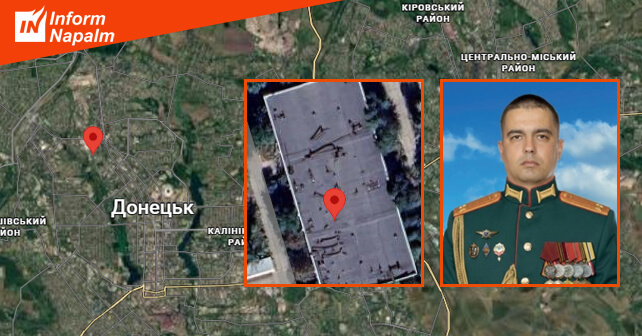
Using the 8 September 2025 strike on Russian command posts in temporarily occupied Donetsk as an example, we show how OSINT verification does not end with the news cycle and can reveal new facts months or even years later.
By “iterative OSINT,” we mean revisiting an already investigated event after a certain period of time, like in this case. Sources that were unavailable on the day of the strike may emerge months later: obituaries, memorial plaques, posts by schools and military academies, regional media reports, and award documents. Taken together, they can help clarify the consequences of operations that were initially known only in part.
What is known about the 8 September 2025 strike
On 8 September 2025, a series of explosions went off in temporarily occupied Donetsk. Ukrainian analysts from the Dnipro OSINT project (Harbuz) geolocated several Russian military facilities that were hit.
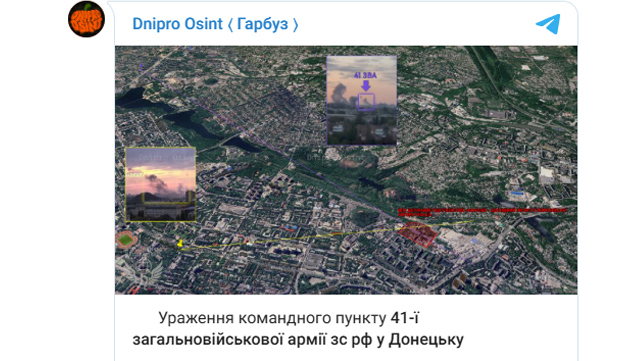
These included the command post of the Russian Armed Forces’ 41st Combined Arms Army, located on the premises of the Research Institute of Integrated Automation, as well as the command post of the 20th Motorized Rifle Division. A strike was also reported on the premises of the former Topaz plant, where an army-level command post may also have been located.
A week later, on 16 September, the General Staff of the Armed Forces of Ukraine officially confirmed the results of the operation. According to the General Staff, on 8 September the Defense Forces carried out a combined strike against Russian command posts in the temporarily occupied territory of Donetsk Oblast. The targets hit included command posts of the Center Grouping of Forces and the 41st Combined Arms Army. The General Staff’s statement itself was published under a headline confirming that enemy personnel, including members of the command structure, had been hit.
The news cycle was effectively over. The OSINT investigation was not.
How a 41st Army staff officer was identified months later
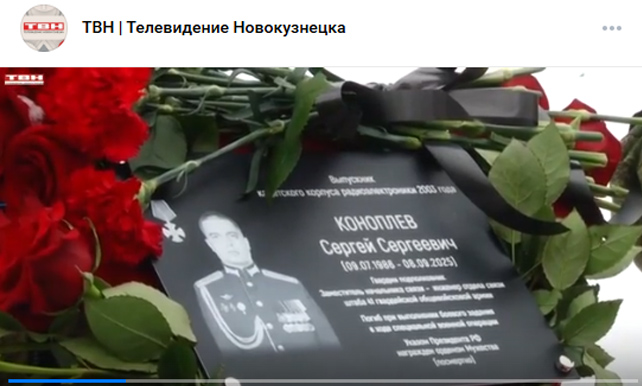
In March 2026, a Russian regional TV channel reported the unveiling of a memorial plaque to Guards Lieutenant Colonel Sergey Sergeyevich Konoplev. The report revealed that he had been killed on 8 September 2025 on a combat mission and had been posthumously awarded the Order of Courage by decree of the Russian president.
On 17 May, the Krapivinsky Municipal District media center published a biographical article about Konoplev that explicitly stated: “On 8 September 2025, he was killed in Donetsk as a result of a missile strike on a command post.”
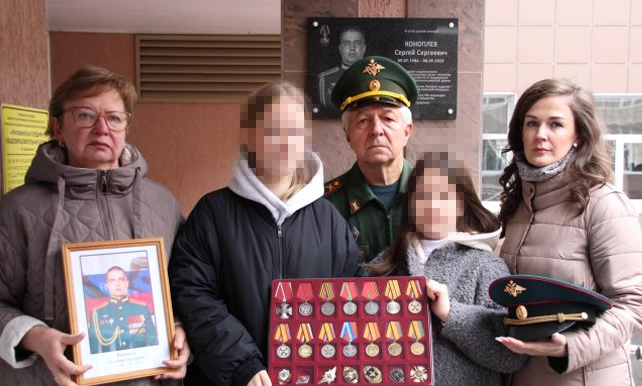
This provided a direct link between the previously documented strike on Russian command infrastructure and the death of a specific officer.
Iterative OSINT: revisiting the incident a year later
On 8 September 2026, exactly one year after the strike, a new memorial post with a detailed profile of Konoplev appeared on the Russian segment of VK. This time, the publication provided a key additional detail: Guards Lieutenant Colonel Konoplev had served as Deputy Signal Officer, Communications Engineer at the headquarters of the 41st Combined Arms Army, military unit 64128.
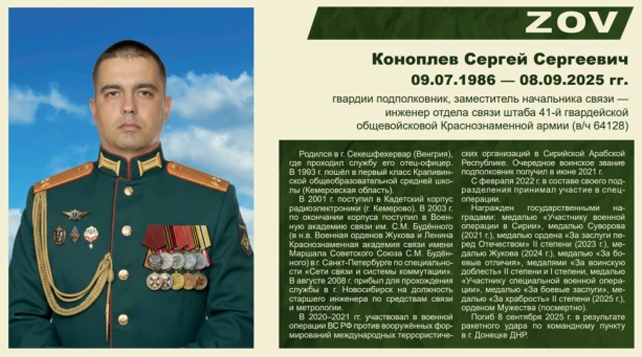
The same profile reiterated that he had been killed on 8 September 2025 in a missile strike on a command post in Donetsk. The new information refined the earlier OSINT findings linking the casualty to a specific position within the headquarters structure of the 41st Army.
Why OSINT verification does not end with the news cycle
Sergey Konoplev was already listed in Mediazona’s extensive database of individually verified Russian military losses.
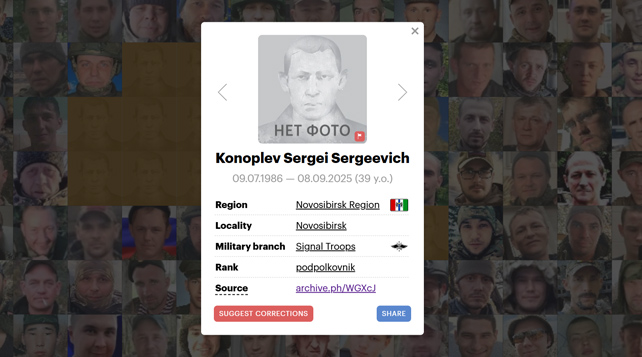
The database records his date of death, rank of lieutenant colonel, and service in the signals troops, but does not include a photograph. A year after the strike, the Russian memorial publication effectively closed that gap as well, adding a photograph, biographical information and his precise position at the headquarters of the 41st Combined Arms Army.
Conclusion
Thus, a year after the incident, open Russian sources allow us to reconstruct one of the consequences of the strike on the 41st Army’s command-and-control system in considerably greater detail.
This sequence demonstrates the practical value of iterative OSINT. The initial investigation established the location and nature of the target. Later sources added evidence of a specific casualty. Still later, another source provided biographical and service details that made it possible to place that casualty within the army’s command structure. Silence in the information space after a strike does not mean that there were no results. Often, it simply means that open-source data are not available at that particular moment.
Russian military structures may conceal losses among their command personnel, but over time information can trickle into the public domain in fragments through local administrations, schools, veterans’ organizations, obituaries and memorial publications.
Effective OSINT therefore requires not only rapid analysis of an event, but also returning to it months and years later, as new information becomes available.
In the case of the 8 September 2025 strikes, this process is probably not yet complete. New names and new details may emerge in open sources.
Read more related material from InformNapalm
- Walking the Path of Fire: Twelve Years of InformNapalm’s War Against the Kremlin
- Ukrainian hackers uncover how Russian drone operators are using Belarus
- OKBMLeaks: classified documents from a Russian components manufacturer for Su-57 fighter and PAK DA Poslannik next-gen bomber
- CYBINT operation against the Gonets satellite system, dubbed “Russia’s equivalent of Starlink”
- Wildberries caught in the crossfire of drone strikes and cyber operations
- Ten years later: from OSINT detection to target destruction. Ukrainian Navy hits Russian Bastion missile system in temporarily occupied Crimea
- Hacktivists uncovered new classified documents from STC, Russian manufacturer of Orlan-10 drones
- CYBINT. Hacking Russian UAV manufacturer. Part 1: who assembles Geran-2?
- AlabugaLeaks. Part 2: Kaspersky Lab and neural networks for Russian military drones
- AlabugaLeaks. Part 3: Albatross, war, NVIDIA, Sony and Saito
- The Russian drone threat 2026–2027: Ukraine’s lessons for NATO
 This publication was prepared by Andriy Lisitsyn especially for readers of InformNapalm volunteer intelligence community. Distribution and reprint with reference to the source is welcome! (Creative Commons — Attribution 4.0 International — CC BY 4.0). Subscribe to InformNapalm social media pages.
 InformNapalm does not receive any financial support from any country’s government or large donors. Only community volunteers and our readers help us to maintain the site. You can also become one of the community volunteers or support InformNapalm with your donations.


No Responses to “Strike on Russian command posts in Donetsk: iterative OSINT revealing officer losses”