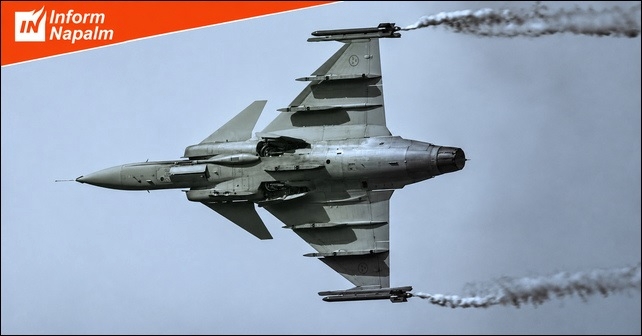
Sweden has received Taurus KEPD 350 cruise missiles from German military stocks. The Swedish Defence Materiel Administration (FMV) confirmed the delivery on 2 November 2026. The announcement follows Sweden’s first test launch of a Taurus missile from a JAS 39 Gripen C in August. Technical integration has also been completed. The Swedish Air Force is now developing the capability to strike military targets deep inside Russia in the event of an armed attack.
According to the Swedish financial daily Dagens industri, the missiles come from German military stocks. FMV has confirmed the delivery, but the number of missiles delivered has not been disclosed. It remains unclear whether the delivery comprises a small number of missiles for testing and integration or a larger stockpile intended for operational use. The German defence publication Hartpunkt highlights the same uncertainty in its reporting on 2 November.
Test launch at Vidsel
On 21 August 2026, the Swedish Air Force launched a Taurus KEPD 350 from a JAS 39 Gripen C for the first time. The test launch took place at FMV’s Vidsel test range in Norrbotten. The Air Force has released a 14-second video clip showing the launch.
🇸🇪 TAURUS LAUNCH
Today a TAURUS KEPD 350 cruise missile was launched from a Swedish JAS 39 Gripen for the first time. The test was conducted at the Vidsel Test Range in Norrbotten.
Today TAURUS is a long-range cruise missile that introduces a new deep-strike capability.
📷 FMV https://t.co/vYcL75Lu4p— Flygvapnet (@flygvapnet) August 21, 2026
According to Hartpunkt’s analysis, the footage also shows a dummy Taurus missile mounted beneath the aircraft. The markings on the missile that was launched also suggested that it was fitted with a warhead. These observations raised questions about the missile’s origin, as the Taurus KEPD 350 is no longer manufactured in its original configuration. At the time of the test launch, the source of Sweden’s missile had not been publicly established.
FMV’s subsequent confirmation establishes that Sweden has received Taurus missiles from German stocks. It does not, however, establish which individual missiles were used during the test launch. Nor does the footage confirm that the entire weapons system is already operationally available.
A weapon designed to strike hardened targets
The Taurus KEPD 350 is an air-launched cruise missile with a published range of more than 500 kilometres. It is specifically designed to strike hardened and protected targets. These include fortified military facilities, protected command centres and other strategically important military installations.
The missile weighs approximately 1,400 kilograms and is equipped with a penetrating warhead. It was developed by Taurus Systems GmbH, a joint venture between MBDA Deutschland and Sweden’s Saab. Sweden thus has longstanding industrial ties to the weapons system.
Its long range allows targets to be struck without the aircraft having to fly directly over them, thereby reducing the potential risk to the launching aircraft. The actual range, however, depends on the flight profile, launch conditions and mission planning. The published range therefore does not necessarily correspond to the distance to the target on every mission.
Swedish strategy allows for strikes deep inside Russia
Sweden’s approach to the role of its Air Force in the event of an armed attack has changed. In an interview with the Swedish daily newspaper Aftonbladet, Colonel Carl Bergqvist, head of the Swedish Air Warfare Centre, outlined the new approach. An aggressor should not expect Swedish forces to confine their defensive operations to Swedish territory.
The Air Force must also be capable of striking the military infrastructure that enables an attack. This may include airbases, command centres and logistics facilities far behind the front line. The aim is to impede further operations and increase the cost of military aggression.
Bergqvist’s remarks concern Sweden’s response to an armed attack. They do not mean that Sweden has decided to launch preventive strikes against Russia. This distinction is central to understanding Swedish defence strategy.
This development is also linked to Russia’s war against Ukraine. Russian forces use long-range missiles and drones against Ukrainian targets from locations far behind the front line. Striking the military assets behind these attacks has therefore become an important part of Ukraine’s defence. Sweden faces the same fundamental military problem. Intercepting incoming attacks is not always sufficient if the adversary remains capable of launching further weapons.
InformNapalm has previously documented the development of Ukraine’s capability to strike Russian missile systems. As early as 2016, the organisation’s analysts identified Russian Bastion coastal defence missile systems on the occupied Crimean Peninsula. In August 2026, InformNapalm reported on Ukrainian strikes against Bastion launch positions and a deployment site on the peninsula. These developments illustrate how Ukraine’s ability to locate and strike Russian military assets has evolved.
NATO membership has also changed Sweden’s defence planning. Since 7 March 2024, the Swedish Armed Forces have formed part of the alliance’s collective defence. Sweden’s long-range strike capability is therefore also relevant to the defence of the Baltic Sea region and other Allied territories.
Plans for even greater range
Taurus, however, represents only part of Sweden’s ambitions. On 25 November 2025, Reuters reported on Swedish plans to acquire weapons systems with ranges of up to 2,000 kilometres. Defence Minister Pål Jonson referred to Russia’s development of cruise missiles, ballistic missiles and long-range drones. The aim is to strengthen Sweden’s deterrence capability.
Such a range would represent a substantial increase compared with Taurus. However, no specific weapons system has been publicly identified to meet this range requirement. Nor has it been established that the capability will rely on weapons launched from Gripen aircraft.
Taurus integration with Gripen has been completed
The integration of Taurus with Sweden’s Gripen aircraft has progressed faster than originally planned. On 24 September 2026, Taurus Systems GmbH announced that technical integration with Gripen had been completed in record time. The announcement came just over a month after the first test launch at Vidsel.
The original plans envisaged the introduction of Taurus on Gripen C in 2028. Integration work has since been accelerated, and the manufacturer’s announcement confirms that an important technical milestone has already been reached. This does not automatically mean that the entire weapons system is operational with Swedish Air Force units. No public confirmation of full operational readiness has been issued.
Operational use requires more than missiles and a compatible aircraft. Mission planning capabilities, technical support and trained personnel must also be available. Hartpunkt highlights in particular the need for a system to transfer the necessary geographical data to the missiles before launch. The size of Sweden’s Taurus stockpile remains unknown.
The integration of Taurus with Gripen E is also part of Sweden’s plans. Discussions are also under way regarding Swedish participation in the development of Taurus Neo, a modernised version of the cruise missile. Germany has already begun preparations for the manufacture of the new variant. According to reports from early November 2026, talks on Swedish participation are ongoing. No final Swedish procurement decision regarding Taurus Neo, however, has been publicly confirmed.
The delivery raises questions about Ukraine
The German delivery is also relevant to the debate over military support for Ukraine. The Ukrainian government has long requested Taurus missiles to strike Russian military targets at long range. Germany’s reluctance to supply the missiles has therefore prompted extensive political debate.
On 3 November 2026, Defense Express highlighted Germany’s delivery of Taurus missiles to Sweden. Ukraine, however, continues to request the weapons system. Any subsequent transfer of missiles from Sweden would require further political decisions and consideration of export-related issues. Nothing in the information released so far indicates that such a decision has been taken.
The delivery of Taurus missiles, the documented test launch and the completion of technical integration mark a shift in the Swedish Air Force’s future role. Sweden is not merely developing its ability to repel attacks. It also aims to be capable of striking the military assets that enable further attacks. The full extent of this operational capability has yet to be publicly established. Nevertheless, these developments mean that a future aggressor must also reckon with Swedish precision strikes beyond Sweden’s borders.
Further articles by InformNapalm
 The material may be freely shared and republished provided that the source is credited. Licensed under Creative Commons Attribution 4.0 International (CC BY 4.0). Follow us on Facebook, X, Telegram and Slate (Sl8).
InformNapalm receives no financial support from any government or institutional sponsor. Its activities are funded exclusively through voluntary contributions from individual volunteers and readers. Those wishing to contribute can do so by making monthly small donations through the BuyMeACoffee platform.