The Russian corvette Merkury has capsized at the naval base in Benghazi following a Ukrainian drone attack on 22 November 2026. Satellite imagery shows that most of the vessel is submerged. Meanwhile, OSINT analysts have documented the loading of military materiel in the Kaliningrad region and subsequent movements of sanctioned cargo vessels through the Baltic Sea. These developments concern the Russian Navy’s combat and transport capabilities in two separate maritime areas. InformNapalm’s previous investigations into the deployment of landing ships in Georgia, Crimea and Syria provide a historical perspective on the evolution of Russian military logistics.
Merkury is a Project 20380 Steregushchiy-class corvette that entered service in 2023. The corvette is attached to the Black Sea Fleet but has also operated in the Mediterranean. According to Libya’s eastern-based government, the vessel had called at Benghazi to refuel and replenish supplies ahead of its return voyage to Russia. The port is located in territory controlled by forces under Khalifa Haftar, which have maintained extensive military cooperation with Moscow for several years.
Merkury capsizes at the naval base in Benghazi
The explosion occurred on 22 November while Merkury was moored at the naval base. Following a preliminary investigation, Libya’s eastern-based government stated that the vessel had probably been attacked by unmanned craft. According to Reuters, ten people, including Russian and Libyan nationals, sustained what were initially described as minor injuries. The Russian authorities had not commented on the incident at the time of reporting.
Satellite imagery from Planet Labs documents a major fire at the berth. Subsequent imagery from Vantor shows that Merkury has capsized and partially sunk. Only the bow protrudes above the waterline, while smoke rises from the superstructure and debris lies scattered along the quay. The images have been published by several news organisations, including the Associated Press. The vessel is no longer in operational service, but it remains unclear whether it can be salvaged and repaired.
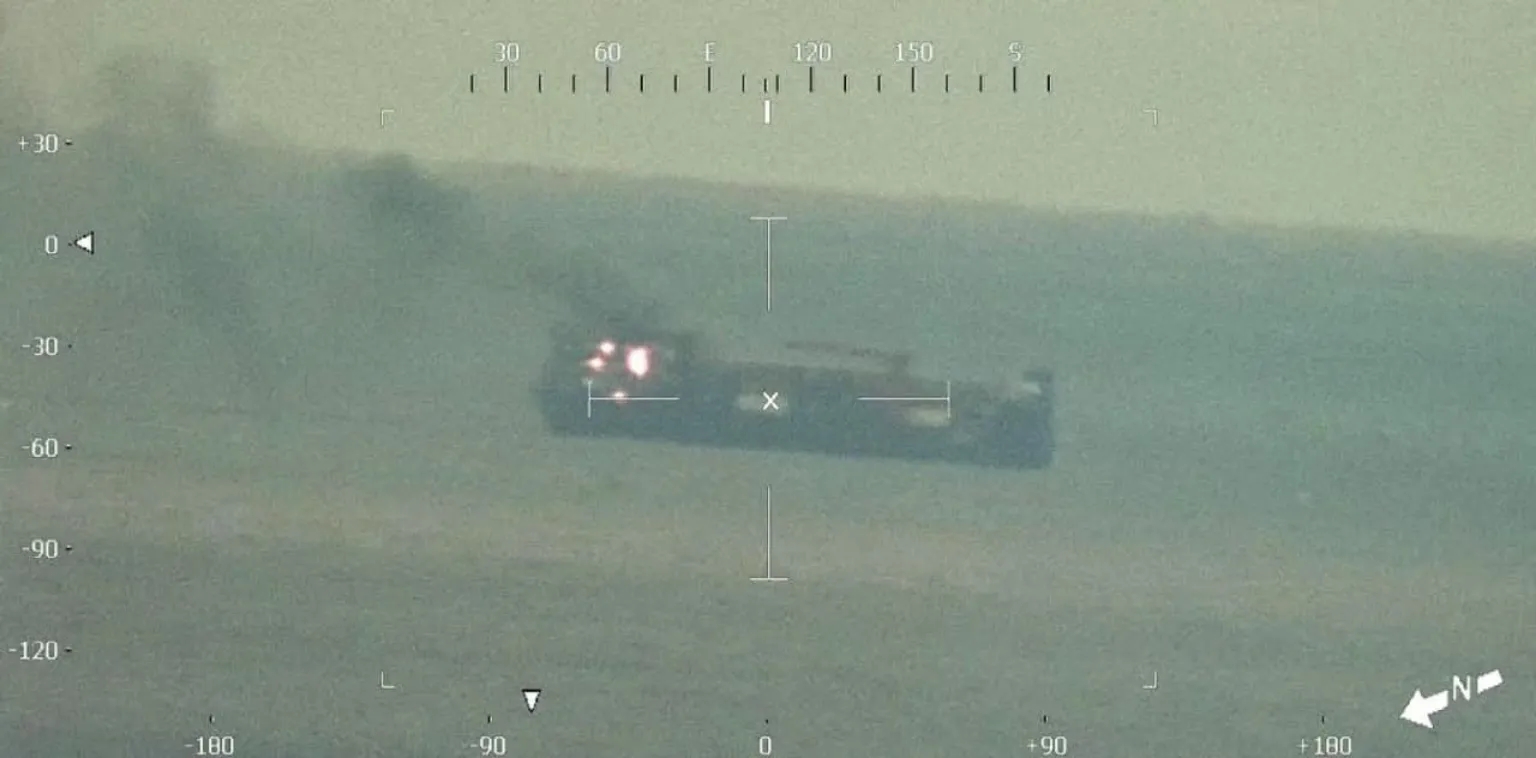
Ukrainian naval drones strike the Russian corvette Merkury and the dry cargo ship MV Angara off the coast of Libya. Video: Security Service of Ukraine (SBU), released on 23 November 2026.
The corvette has a standard displacement of approximately 1,800 tonnes and is equipped with the Uran anti-ship missile system, the Redut surface-to-air missile system and the Paket-NK anti-submarine and anti-torpedo system. Project 20380 is designed for missions including surface warfare, anti-submarine warfare and air defence. The Russian Navy has thus lost access to a modern surface combatant whose duties may also include the protection of maritime transport routes.
Two unnamed representatives of eastern Libyan forces told the Associated Press that Ukrainian unmanned surface vessels had carried out the attack. According to their accounts, at least four vessels were destroyed before reaching their target, while two struck the corvette. The representatives also claimed that the vessels had been dispatched from a facility in western Libya. On 23 November, the Security Service of Ukraine (SBU) confirmed that the attacks on Merkury and the dry cargo ship MV Angara had been carried out jointly by Ukraine’s defence forces and the SBU. The claim that the vessels had been dispatched from a facility in western Libya has not been confirmed by the Ukrainian authorities.
Later on 22 November, Reuters reported another attack on a merchant vessel off Benghazi. The vessel was initially reported to be flying the Maltese flag, which Malta’s Home Affairs Minister Glenn Bedingfield denied on 23 November. According to TVMnews, the minister identified the vessel as Ascalon, while the SBU identified the dry cargo ship that had been attacked as MV Angara. Libyan naval forces rescued the crew. Local military sources also reported that more than twenty unmanned surface vessels had been neutralised off the coast. Libya’s eastern-based government has called for an international investigation into the incidents and expressed suspicions concerning Ukrainian activities in western Libya.
Russian military shipments from the Kaliningrad region
On 15–16 October, the OSINT projects GeoInsider and SONARROW_OSINT documented the loading of military materiel in the Kaliningrad region. Satellite imagery shows infantry fighting vehicles, armoured personnel carriers, mine-protected vehicles and military logistics vehicles alongside three cargo vessels. These were identified as Ascalon (IMO 9198226), Lady D (IMO 9349289) and Anastasiia (IMO 9349291). The Insider has published the imagery and vessel identification details.
Ascalon has previously been used as part of the so-called Syrian Express, the maritime supply route that sustained Russian military forces in Syria. Anastasiia was documented unloading military materiel at the Libyan port of Tobruk in September 2026. Satellite imagery of the port call shows Russian Ural military lorries, among other equipment. All three vessels are subject to US sanctions.
A subsequent observation at Baltiysk on 27 October shows Lady D berthed at the quay next to the cargo vessel Sparta, which, according to the published documentation, was loading military vehicles. A Russian Steregushchiy-class corvette was also present in the port area at the time. The loading operations illustrate how Russia uses merchant vessels and naval facilities to organise long-distance military shipments.
Russian cargo vessels under naval surveillance
In early November, several cargo vessels left the Baltic Sea region. Ascalon and Anastasiia were observed travelling westwards, while Lady D, Lady R and Maia-1 followed as a separate group. The latter group passed through the Great Belt on 7 November and rounded Skagen the following day. The OSINT project V4RDE Insights has tracked the movements using AIS data, Sentinel-1 satellite radar imagery and photographs from the Danish straits.
A Sentinel-1 radar image acquired on 7 November at 05:32 UTC shows the three cargo vessels and an additional radar return with no corresponding AIS position. V4RDE assesses that the return probably originates from an escorting warship. Photographs taken on the same day show the Russian corvette Stoikiy, hull number 545, in the vicinity of the group of cargo vessels. Like Merkury, Stoikiy belongs to Project 20380. The link between the radar return and the photographed corvette remains tentative, as it has not been established that the observations refer to the same position.
On 8 November, the Danish patrol vessel Rota (P525) passed at distances of between 483 and 800 metres from the three Russian cargo vessels off Skagen. AIS records indicate brief encounters rather than a continuous Danish escort. The Russian vessels maintained a speed of approximately 10–11 knots during the passage.
Lady D and Maia-1 belong to the sanctioned shipping company MG-Flot. According to information from the Swiss authorities, the company has been linked to shipments of North Korean weapons to Russian military facilities. Lady R has previously been observed in connection with suspected ammunition shipments from the North Korean port of Rason. These findings concern the vessels’ previous activities and do not establish the nature of their cargo during the voyages in question.
The documented shipments demonstrate the recurring use of merchant vessels for military missions. Observations in the Great Belt suggest that a Russian corvette has been assigned to escort duties, although the identity of the escorting vessel has not been conclusively established. An increase in military transport activity could therefore affect the allocation of available corvettes and frigates across the Navy’s various operational theatres.
InformNapalm’s investigations from the war in Georgia to Syria
Since 2015, InformNapalm has investigated Russia’s use of landing ships and other naval transport assets. The investigations also cover Russian military units and crews that participated in the invasion of Georgia in 2008 and the occupation of Crimea in 2014. One of the vessels documented is the Project 1171 landing ship Saratov, which belonged to the Black Sea Fleet’s 197th Landing Ship Brigade.
On 12 August 2008, the Black Sea Fleet’s large landing ships Yamal and Saratov landed Russian troops in the Georgian port city of Poti. During the operation, Saratov was commanded by Captain 2nd Rank Oleg Pochinov. In an investigation published in January 2021, InformNapalm identified members of Saratov’s crew who subsequently participated in Russia’s occupation of Crimea. The investigation draws on photographs, social media and Russian military decorations, among other sources.
The importance of landing ships to Russia’s military logistics
InformNapalm has also investigated the transport missions undertaken by landing ships during Russia’s intervention in Syria. In September 2015, InformNapalm published The war in Syria and how the Russian Navy supports President Bashar al-Assad, based on OSINT analyst Anton Pavlushko’s compilation of vessel movements through the Bosphorus and the Dardanelles. The investigation covers the period from 2013 to September 2015 and details the vessels’ fleet affiliations, transport capacities and frequency of passage.
During this period, a total of more than 300 passages by Russian warships through the Bosphorus were recorded, counting both directions. The data cover more than 50 vessels from Russia’s four fleets. The Black Sea Fleet’s large landing ships accounted for a substantial proportion of the shipments to Tartus, although vessels from the Northern, Baltic and Pacific fleets were also deployed. InformNapalm’s research thus documented how the Russian Navy’s amphibious capabilities were employed in recurring military supply missions.
During the same period, InformNapalm also investigated military movements from occupied Abkhazia. In September 2015, shipments were documented from the area around Russia’s 7th Brigade in Gudauta towards Sochi. The materiel included tanks, artillery systems and military transport vehicles. The assessment at the time considered the possibility of onward transport to Syria via Novorossiysk. The documentation is available in InformNapalm’s investigation into military movements from Abkhazia.
Transport operations from the Kaliningrad region during the autumn of 2026 reflect a partial shift in how Russia organises its military shipments. Russia now uses sanctioned merchant vessels with a history of military transport missions and assigns naval escort assets to them when required. During the intervention in Syria, a substantial proportion of the shipments were carried directly by large landing ships of Projects 775 and 1171. Both arrangements make use of vessels that are also needed for the Navy’s operational duties.
Libya’s importance to Russia’s military presence in Africa
Russia’s military activities in Libya are closely linked to Khalifa Haftar’s forces in the eastern and southern parts of the country. Moscow has gained access to ports and airbases used for military shipments and to support operations on the African continent. Following the reorganisation of the Wagner Group, the Africa Corps, which operates under the Russian Ministry of Defence, has assumed a prominent role in these activities.
In the report Beyond Wagner: Russia’s Military Engagement in Africa in the 2020s, published on 7 October 2026, FOI researcher Anna Ida Rock examines the evolution of Russia’s military engagement in Africa. These activities include the Africa Corps, military cooperation with African states, maritime links and arms deliveries.
Following the fall of the Assad regime in Syria in December 2024, Russia’s access to the military facilities at Tartus and Khmeimim has become subject to new agreements. Meanwhile, ports in eastern Libya provide links to Russian military operations in Africa. The documented unloading of Anastasiia in Tobruk in September 2026 demonstrates that Russian cargo vessels continue to be used to deliver military materiel to the country.
Merkury’s port call in Benghazi confirms that Russian warships also use Libyan port facilities for refuelling and replenishment. The attack has therefore hit a modern corvette at a support hub for Russian naval operations in the Mediterranean. If Merkury remains out of service for an extended period, Russia’s available surface combat capability will be reduced at a time when it is conducting military-related maritime shipments to the region.
Sparta II attacked in the Gulf of Finland
On 21 November, the Russian cargo vessel Sparta II was struck by drones in international waters west of the Russian island of Hogland in the Gulf of Finland. The vessel caught fire and subsequently drifted into Finnish territorial waters. All sixteen crew members were evacuated to a nearby Russian vessel. One crew member sustained minor injuries. According to Reuters, the operation to tow the vessel out of Finnish waters began on 22 November.
The Russian cargo ship Sparta II on fire in the Gulf of Finland on 21 November 2026. Photo: Finnish Border Guard (Rajavartiolaitos).
Sparta II is owned by Oboronlogistika, which provides logistics services to the Russian Ministry of Defence. The vessel is subject to US sanctions and was en route from St Petersburg to Kaliningrad. The Finnish Defence Forces have assessed that Ukraine probably carried out the attack.
Within the space of two days, both a Russian military-linked cargo vessel and a modern corvette have sustained extensive damage in separate maritime regions. No operational connection between the attacks has been established. Through its operations in the Black Sea, Ukraine has already inflicted substantial losses on the Russian Navy and affected its basing arrangements. The attack on Merkury shows that Ukraine has also used naval drones against a Russian warship in the Mediterranean.
Russia’s long-distance maritime transport operations require continued access to shipping tonnage, port facilities and naval escort assets. As a result of the damage to Merkury, the Russian Navy has one fewer Project 20380 corvette at its disposal. Sparta II, one of the vessels used for military-related shipments, has also been damaged. InformNapalm’s previous investigations have demonstrated how Russia’s military operations in Georgia, Ukraine and Syria have been supported by recurring maritime movements. The latest attacks have once again hit vessels used to sustain these operations.
On 25 November, the Associated Press reported, citing the Libyan National Army, that two Libyan naval officers had died of their injuries on the evening of 24 November.
Further articles by InformNapalm
 The material may be freely shared and republished provided that the source is credited. Licensed under Creative Commons Attribution 4.0 International (CC BY 4.0). Follow us on Facebook, X, Telegram and Slate (Sl8).
InformNapalm receives no financial support from any government or institutional sponsor. Its activities are funded exclusively through voluntary contributions from individual volunteers and readers. Those wishing to contribute can do so by making monthly small donations through the BuyMeACoffee platform.