

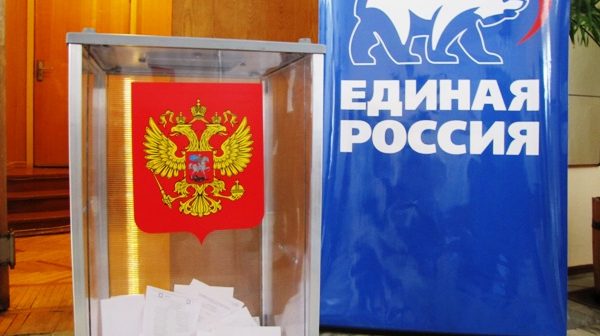
The ruling United Russia, political party of President Vladimir Putin, comfortably won a parliamentary election in Russia on September 18, despite an economic recession due to the fall in oil prices and the Western sanctions linked to the annexation of Crimea by Moscow. Official results in Russia’s parliamentary elections show that United Russia heads the polls with 54.3 percent. Putin and Medvedev’s party is followed by the Communist Party with 13.5 percent, the far-wing Liberal Democratic Party (LDPR) with 13.3 percent, and Fair Russia party with 6.2 percent.
United Russia wins the majority for the fourth consecutive time; moreover, the top-four parties are the same for the fourth election in a row. Communists, LDPR and Fair Russia have been widely dubbed as “systemic opposition” groups because of their loyalty to the Kremlin on all major issues. All three of those parties tend to vote with United Russia in parliament, and avoid direct criticism of Putin. Other parties were not able to pass the five percent threshold required to secure seats in the State Duma.
Election result was so predictable that most Russians did not bother to go to their polling stations. As a result, turnout dropped to a record low of 47.8%. One reason for such apathy is the belief in the society that elections wouldn’t change anything in the country.
United Russia also won 203 seats out of 225 in single-constituency districts. When both combined, the election outcome see the pro-Kremlin party control 343 mandates in the 450-seat State Duma, which makes 76.22% of seats, according to the results of the Central Election Commission. The Communist Party gained 42 mandates (9.34%), the Liberal Democratic Party – 39 mandates (8.67%), Just Russia – 23 mandates (5.11%), Rodina, Civic Platform and independent Vladislav Reznik (an oligarch, formerly United Russia MP) — gained one mandate each.
By achieving a constitutional majority, the Putin-controlled party has now the right to amend Russian Federation’s constitution without the backing of other parties, which are still not a real opposition but only a “systemic opposition”.
Shortly after the polls closed Vladimir Putin was at the party’s headquarters alongside Russian Prime Minister and party leader Dmitry Medvedev to praise the result. Putin said the win showed voters still trusted the leadership despite an economic slowdown made worse by Western sanctions. Putin added the result was proof that United Russia remains “the leading and best political force”, but he also warned the party “could not rest on its laurels because people are struggling in their daily lives”.
According to organizations monitoring elections, United Russia has been routinely depicted in a favorable light by the Russian state television. The ruling party also benefited from its association with Vladimir Putin, who after 17 years in power, president or prime minister, has a personal approval rating of about 80 percent. Many Russians are persuaded by the state TV narrative that the West is using sanctions to try to damage Russian economy in revenge for Moscow’s annexation of Crimea.
Vladimir Putin is widely expected to seek another term in March 2018, which would be a fourth presidential term overall. But he said that it’s too early to say if he will go for it. If he does and wins, he would be in power until 2024, which means longer than 1970-80ss Soviet leader Leonid Brezhnev.
LDPR leader Vladimir Zhirinovsky, well-known for his radical comments, said: “We don’t have the same support as United Russia, it’s not the party itself but the entire might of the state”. He also expressed outrage at the low turnout, saying that “57 million people ditching the vote is a shame”.
These sentiments seem to be shared by the Communist leader Gennady Zyuganov who described United Russia’s result as “deceitful”. “There were no real debates, fake parties were created to withdraw votes”, he said. Zyuganov added that his hopes that “this campaign would be fairer, more responsible and dignified given the crisis within the country” have been vanished.
The liberal opposition parties Yabloko and Parnas will not have a single Duma representative. Commenting the results on the Dozhd TV, Yabloko’s Lev Schlosberg said: “I want to say that I am sorry. We couldn’t get through this iron curtain to our voters. We failed to engage our voters in discussion. They don’t believe in elections anymore, and they stayed home. This is our fault, and our responsibility.”
Parnas leader Mikhail Kasyanov also blamed voters’ apathy and said his party was punished by a disappointing low turnout. “Unfortunately, Russians stopped believing that such an important democratic institution such as an election can change anything. Through the campaigning we were trying to wake up our citizens and call on them to believe that there’s a chance, but I see that our calls were not successful”, Kasyanov resumed.
There are voices saying that the opposition was at a disadvantage. Anti-corruption activist Alexei Navalny, who in 2011 was a popular opposition leader, has been sidelined from politics by charges, which were widely considered as politically motivated. He was not able to run himself in this election, but he didn’t use his popularity to encourage Russians to vote for opposition parties, instead he decided to boycott the vote, the Moscow Times reported.
Another critic of the Kremlin, a former oil tycoon Mikhail Khodorkovsky is now in exile. He blamed the Kremlin in his on Facebook: “They were ‘elections without a choice’. People showed their attitude, with a turnout that is the lowest in years.”
The turnout in Russia’s parliamentary election of 47,8% was the lowest in recent history. In big cities of Moscow and St. Petersburg, home to Russia’s more progressive citizens, its educated middle classes and traditionally more protest-oriented people, the numbers were even lower. Citizens largely abstained from voting. Moscow and St. Petersburg both saw widespread protests after vote tampering in the 2011 parliamentary elections, followed by a police crackdown and mass arrests. This time, despite reports about fraud, there were no rallies.
In fact, United Russia won 54 percent of the general vote, it’s 25 million votes translated into real numbers. It means that United Russia’s victory, which seems to be impressive, has been secured by not even a fourth of the national electorate.
There have been video footage published showing many cases of vote tampering, ballot stuffing and other flagrant violations. It suggested that outside factors may have influenced the vote result.
Russian Central Election Commission chief Ella Pamfilova declared the election to be completely legitimate. However she acknowledged that she had received reports of so-called “carousel voting”, where a group a people cast votes several times in different stations, in the Siberian city of Barnaul. She said if the reports are confirmed, the commission will call for criminal prosecution and consider canceling the result in that city. She added that everything was “going normally” in other regions. Election chiefs said were was no evidence of large-scale cheating.
However, there were still questionable incidents elsewhere, one of them in Rostov in southern Russia where a CCTV camera caught a polling official stuffing a box with ballots already filled in. A woman is seen putting a number of ballots into the ballot box while two others were hiding her from the observers. The local electoral commission and the Investigative Committee said they are looking into this incident.
Golos, an independent organization monitoring elections, said it had received floods of reports of vote-cheating but there was little it could do through official channels. “We don’t have any way to fight it through law enforcement agencies or through courts but we fight violation through attracting public attention,” Roman Udot, co-chair of Golos told the BBC.
Russian election came under sharp criticism from observers from the Organization for Security and Cooperation in Europe and the Parliamentary Assembly of the Council of Europe. The organization categorized one-third of the polling stations visited as “bad” or “very bad.”
The group’s fundamental critique concerned the overall framework of the campaign, which had given opposition candidates little chance. Tonino Picula, former Croatian foreign minister, who led one group of observers, said: “The point of elections is that the outcome should be uncertain. This was not the case in Russia. There was no real competition, and abuse of government resources ensured that the ultimate winner of the election was never in doubt.”
According to the OSCE, Russian elections were transparently administered by the Central Election Commission, but challenges to democratic commitments remained. “The electoral environment was negatively affected by restrictions to fundamental freedoms and political rights, firmly controlled media and a tightening grip on civil society”, the international observers concluded in a statement.
Even more controversially, this Russian parliamentary election was the first time people were voting in Crimea, the peninsula annexed from Ukraine in 2014, a Moscow’s action which was internationally condemned. In total, 8 members were elected to the Russian State Duma in Crimea, recognized as a part of Ukraine by international laws and resolutions.
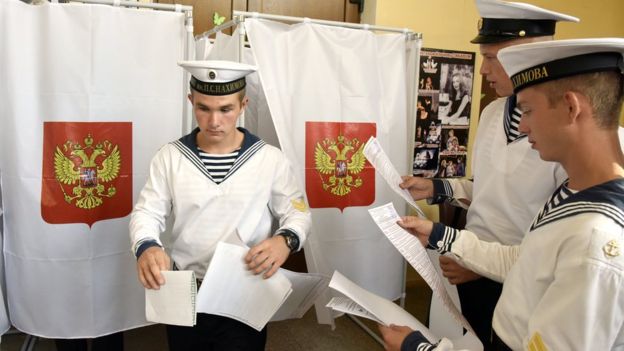
Black Sea Fleet sailors vote in the Crimean port of Sevastopol – 18 September
A range of countries, such as USA, Canada, Sweden, Poland, Lithuania, Romania, France and the UK, alongside the Parliamentary Assembly of the Council of Europe and the EU have denounced the election to the Russian parliament in Crimea as illegitimate. “The preservation of the sovereignty and territorial integrity of Ukraine constitute a crucial condition for the peaceful solution of the Russian-Ukrainian conflict,” the Polish foreign ministry said in a statement.
Ukraine recognized the newly elected Russian State Duma and all its decisions illegitimate. Ukrainian Parliament adopted a resolution on non-recognition of the legitimacy of the elections to Russian State Duma of the seventh convocation with all the ensuing legal consequences. Accordingly, the composition, authority, acts and decisions of the Duma are also seen as illegitimate, Verkhovna Rada stated.
Ukraine has also appealed to the UN Security Council and the General Assembly, the parliaments of foreign countries and international organizations not to recognize the legitimacy of the elections to the Russian State Duma. These developments may further undermine the peace process in Donbas and Ukraine-Russia relations eventual normalization. It can also have legal consequences for Russia on the international level. On the other hand, officials in Moscow hope that, if no major international reaction, it may pave the way to the legalization of the seizure of Crimea.
But it’s not the only trap. Nikolai Petrov, a political analyst with the Higher School of Economics, claims Russian leadership has unwittingly driven themselves into two traps. First one is linked to political legitimacy while the second trap is an excessively long interval between the parliamentary elections and the presidential elections in 2018. In order to keep the population’s support Putin will have to deal with economy recession and sanctions and implement painful reforms or to end the confrontation with the West.
However, some analysts say there is possibility that the Kremlin leader with the help of the Duma organizes next presidential election earlier. The new parliament will serve the Kremlin more than before, as United Russia’s constitutional majority allows it to pass any legislation the Kremlin wishes. The election result means that significant changes in Moscow’s policy on Ukraine and Syria wars and on its relations with the West are rather unlikely to happen.
So, Moscow’s stance on major issue is going to be unchanged. On the other hand, the Kremlin received the signal on people’s deception about the political system as Russians seem to care more about every-day problems linked to economy crisis than about their leadership’s “achievements” in Syria and Ukraine. Thus, fears of instability and protests, as well as a range of major challenges and a fully-controlled parliament, may push Vladimir Putin to switch to an even more rigid and authoritarian rule.
Author: Michael
 (CC BY) Information specially prepared for InformNapalm.org site, an active link to the authors and our project is obligatory for any reprint or further use of the material.


No Responses to “Russian Election: More Rigid Putin’s Rule Expected as United Russia Secures Constitutional Majority”