

On September 7, Russian drones struck a major British American Tobacco production facility in Pryluky. For Ukraine, this is another blow to the civilian economy. For Russia, this is a reason to look back at its own tobacco industry: more than 200 billion cigarettes annually and over 1 trillion rubles in excise taxes, which the federal budget is expected to receive in 2026.
A strike on an operating production facility
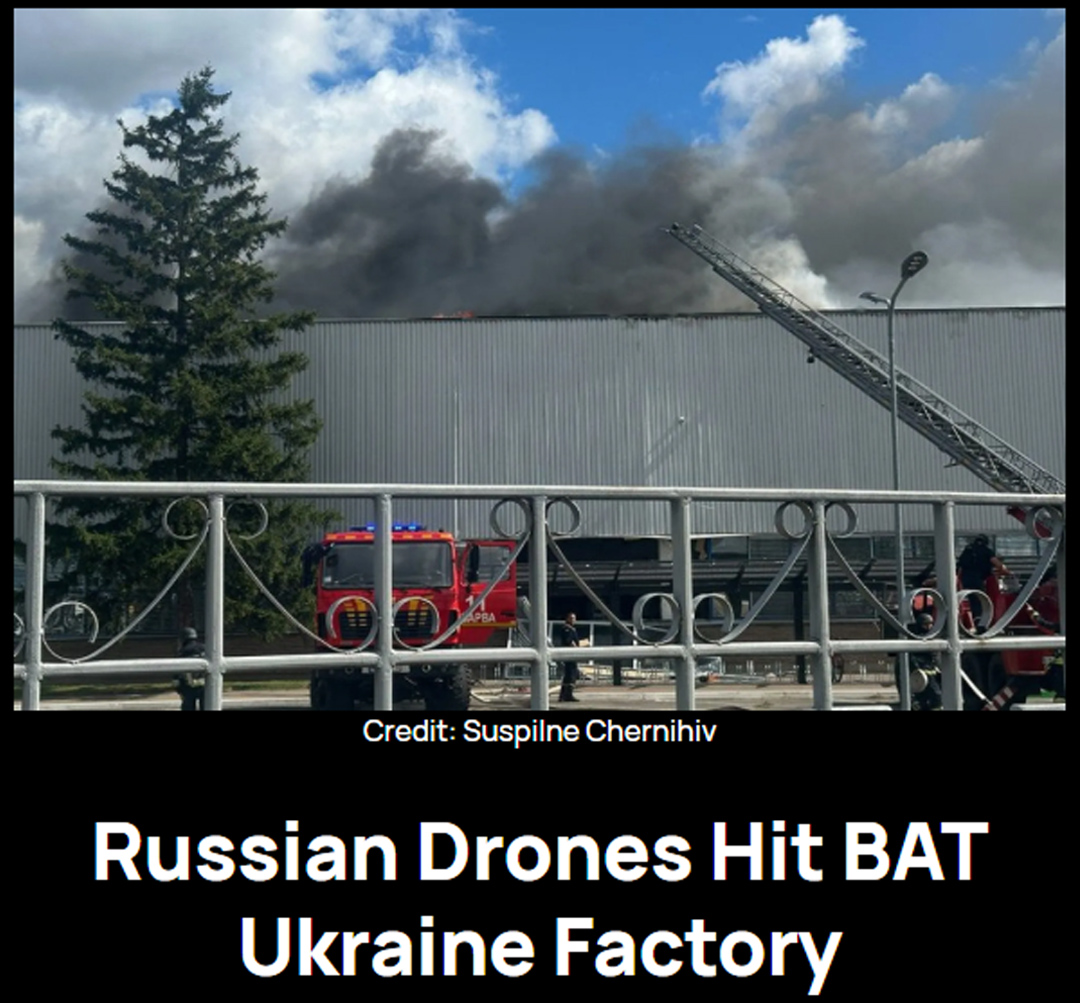
On the afternoon of September 7, Russian drones attacked the operating British American Tobacco (BAT) production facility in Pryluky, Chernihiv Oblast. BAT confirmed damage to production and warehouse facilities. According to workers, the roof of the cigarette production area caught fire after the strike.
The international industry publication Nicotine Insider also described the incident as a strike directly affecting the factory’s production operations.
This is important: the strike affected not only warehouse or auxiliary infrastructure, but an operating production facility that had continued working throughout the full-scale war. In 2026, BAT reported that around 800 people work for the company in Ukraine, more than 400 of them in Pryluky, while the facility’s products are exported to the EU, the Middle East and Central Asia.
According to BAT’s own data, the company’s Ukrainian operations paid more than UAH 38 billion in taxes and other payments to the state budget in 2024. This figure applies to BAT Ukraine as a whole, not just the Pryluky facility.
Not the first attack on the tobacco sector
The attack on BAT is the latest in a series of Russian attacks on tobacco assets in Ukraine. Confirmed cases reported in open sources include:
- May 3, 2022 – Philip Morris, Kharkiv region. A fire broke out in an administrative building on the company’s premises following Russian shelling. The court documents record damage to approximately 800 square meters of facilities and criminal proceedings over violations of the laws and customs of war.
- May 28, 2023 – Imperial Tobacco, Kyiv. During a massive Russian attack, the building of Imperial Tobacco’s operating Kyiv factory was damaged. According to Forbes, at least one wall at the end of the plant was destroyed. At that time, the factory was operating and, in addition to producing its own brands, fulfilled orders for Philip Morris, which was unable to use its facility in the Kharkiv region.
- January 30, 2026 – Philip Morris, Kharkiv region. A Russian missile hit a warehouse building, causing fire that spread across more than 5,000 square meters. Production at this factory had been halted back on 24 February 2022. Philip Morris later estimated the damage at approximately $16 million.
- July 8, 2026 – Philip Morris, Kyiv. During a massive Russian attack, a warehouse of finished goods was completely destroyed. The company called this the fourth attack on its assets since the beginning of the full-scale intrusion.
- Night of August 5, 2026 — JTI and Imperial Brands. A Russian attack destroyed a JTI Ukraine finished goods warehouse in Kyiv region. Imperial Brands Ukraine reported the loss of its products stored at warehouses operated by distributors and retail partners.
- September 7, 2026 – BAT, Pryluky. Russian drones struck a major operating facility. BAT officially confirmed damage to production and warehouse facilities, while workers reported a fire in the cigarette production area.
Thus, Russian attacks have repeatedly affected production facilities, warehouses and logistics assets belonging to Philip Morris, Imperial Tobacco, JTI and British American Tobacco.
The recurrence of these incidents has also been noted by international industry media. Nicotine Insider opened its report on Pryluky with the words: “Russia’s latest attack on Ukraine has hit the tobacco industry again” — effectively placing BAT alongside the previous attacks that affected JTI, Imperial Brands and Philip Morris.
The reaction from Russia’s pro-war information space is also telling.
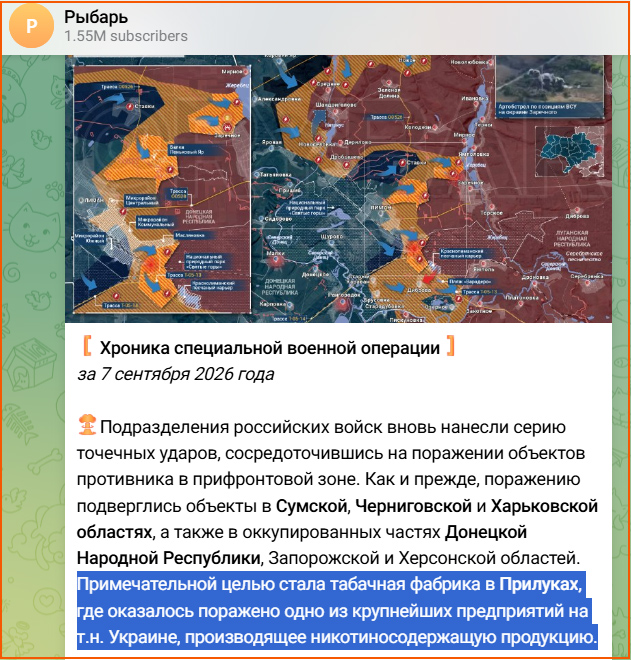
The large pro-war Z-channel Rybar, with millions of followers, described a Russian “series of precision strikes” in its 7 September chronicle and singled out the Pryluky tobacco factory as a “notable target,” emphasizing the scale of the facility.
Part of a broader attack on the civilian economy
The strike on BAT should be viewed not only as another episode in the attacks on tobacco assets, but also as part of a broader trend: Russian strikes are increasingly hitting civilian manufacturing, warehouses, retail and logistics.
Since February 2022, Russian strikes have regularly destroyed civilian warehouses, distribution centers, retail facilities and major civilian production sites across Ukraine. But in 2026, this tactic has scaled up further.
Forbes has already described the situation as a “new phase of the war” for Ukrainian businesses: after suffering major losses, companies are being forced to disperse their inventories, duplicate logistics chains and rethink their warehouse infrastructure.
On 3 September, Russian drones damaged a Coca-Cola plant near Kyiv.
On 8 September, the day after the strike on BAT, Russian forces attacked Pryluky again, hitting an Epicentr shopping center. The same shopping center was already hit by a Russian attack on May 19, 2026.
That same night, the 7th Kilometer retail market near Odesa was damaged. According to local authorities, three people were injured.
A mirror image: Russia’s tobacco market
According to Rosstat, Russian companies produced 209 billion cigarettes in 2025, a 7.5% increase over 2024. In January–July 2026, production reached another 120 billion cigarettes.
This is a mass market producing hundreds of billions of individual product units every year. At the same time, a significant part of the market remains tied to international corporations.
JTI: more than 40% of the traditional tobacco segment
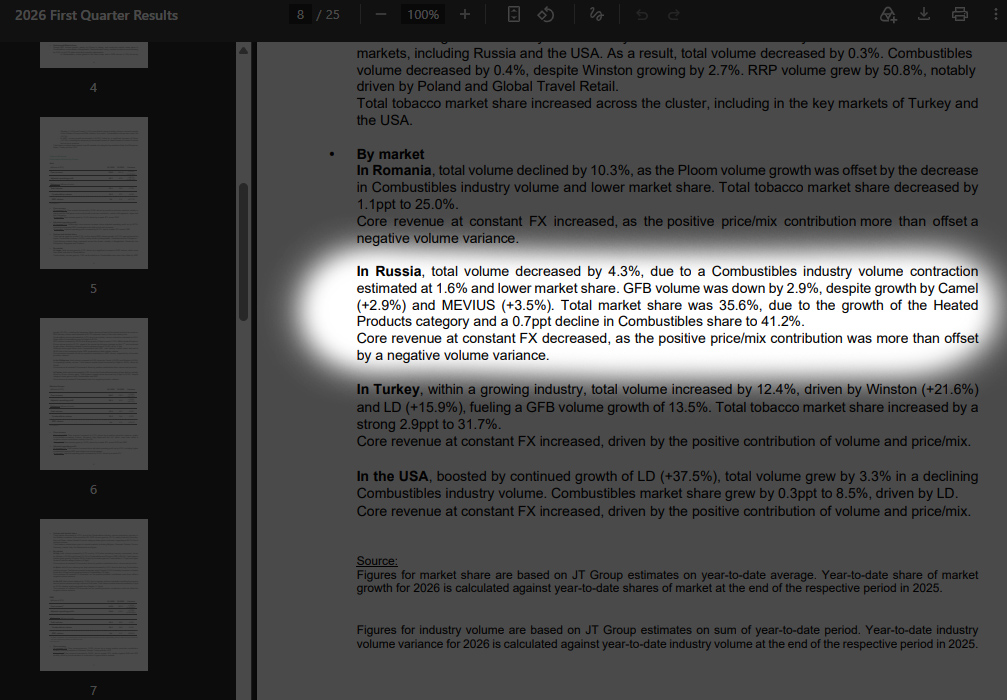
Japan Tobacco International describes itself as the leader of the Russian tobacco market. According to JT Group’s first-quarter 2026 report, JTI held 41.2% of Russia’s traditional tobacco products segment and 35.6% of the overall tobacco market, including heated tobacco products.
JTI has four production sites in the Russian market: two factories producing finished tobacco products and two facilities involved in tobacco leaf processing.
This means that four and a half years after the start of the full-scale war, a single international corporation still controls more than two-fifths of Russia’s traditional tobacco products segment.
Philip Morris: Russia still accounts for about 6% of global revenue
Philip Morris International also continues to operate in Russia. The company’s website lists around 3,200 employees and two Russian production facilities; all PMI cigarettes sold on the Russian market are produced directly in Russia.
According to PMI’s financial reporting, in 2025 Russia accounted for approximately 9% of the company’s global shipments of cigarettes and heated tobacco products and about 6% of its global net revenue.
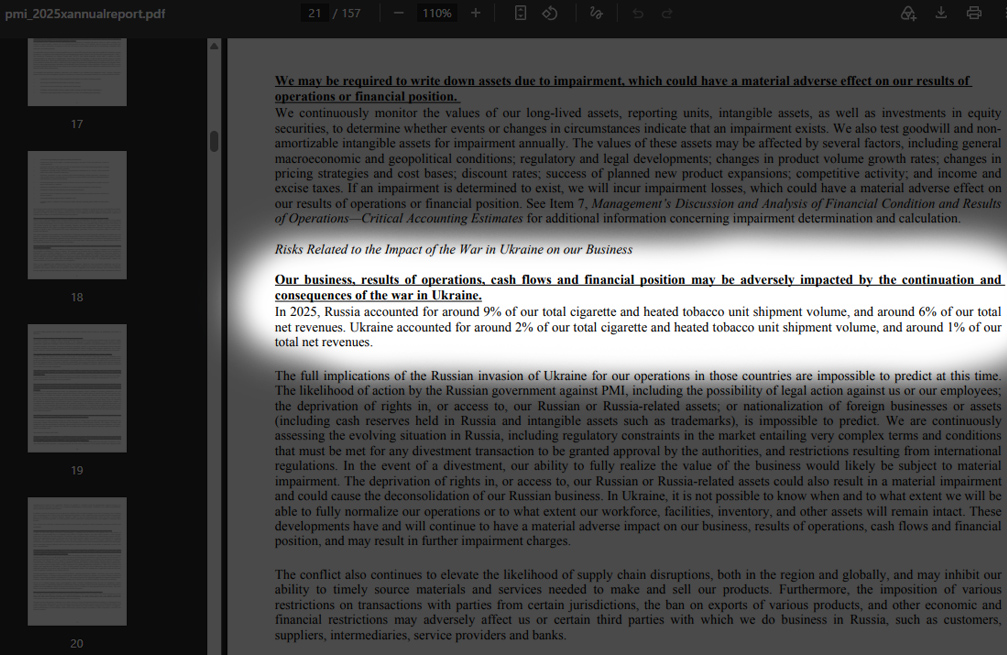
The tax component is particularly telling. In its official annual report filed with the SEC, Philip Morris reported that in 2025 it paid in Russia $348 million in corporate income tax alone. For comparison, in August 2023, when Ukraine’s National Agency on Corruption Prevention (NACP) included PMI on its then-list of “International Sponsors of War,” it cited over $136 million in Russian corporate income tax paid in 2022.
BAT and Imperial Brands exited the Russian market
British American Tobacco completed the sale of its Russian and Belarusian assets to a consortium of local management in September 2023. BAT officially stated that following the deal, it would no longer have a presence in these countries and would receive no financial benefit from subsequent sales. The former BAT business continued to operate as Russia’s ITMS Group.
According to its annual report, Imperial Brands transferred its Russian assets to local investors in April 2022 for £20 million.
Therefore, when it comes specifically to the current direct presence of international corporations in the Russian tobacco market, PMI and JTI remain the key companies for analysis.
The “tobacco trillion”: how much does the Russian budget receive?
The key economic indicator is not only production volume, but also the tax revenue stream.
According to Russia’s budget estimates, in 2026, excise taxes on tobacco products sold domestically are expected to bring in approximately:
1.036 trillion rubles.
Another 46.6 billion rubles is expected from imported tobacco products.
For comparison, total planned federal revenues amount to approximately 40.283 trillion rubles. Domestic tobacco excise taxes therefore account for about 2.57% of all federal revenues — roughly one out of every 39 rubles.
The “National Defense” section of the 2026 budget allocates approximately 12.93 trillion rubles. Domestic tobacco excise revenue is therefore equivalent to roughly 8% of that amount. For comparison, approximately 981.9 billion rubles in tobacco excise revenue was forecast for 2025. In other words, expected receipts are growing by about 5.5%.
This does not mean that tobacco excise taxes directly finance military procurement. But budget funds are fungible: a stable 1.036 trillion-ruble revenue stream from a civilian market increases the overall pool of resources available to the state and can potentially allow more of its own funds to be directed to other spending categories, including military expenditure.
Against the backdrop of a growing budget deficit, this stability becomes even more significant. According to Reuters, Russia’s federal budget deficit reached 2.8% of GDP in January–July 2026, compared with an official target of 1.6% for the full year.
And how many Kalibr missiles is that?
In October 2025, Militarnyi published data from Russian procurement documents it had obtained. The documents indicated that the Russian Ministry of Defense had signed contracts for another 450 3M14 Kalibr cruise missiles for delivery in 2025–2026, with an estimated contract price of approximately 168 million rubles per missile.
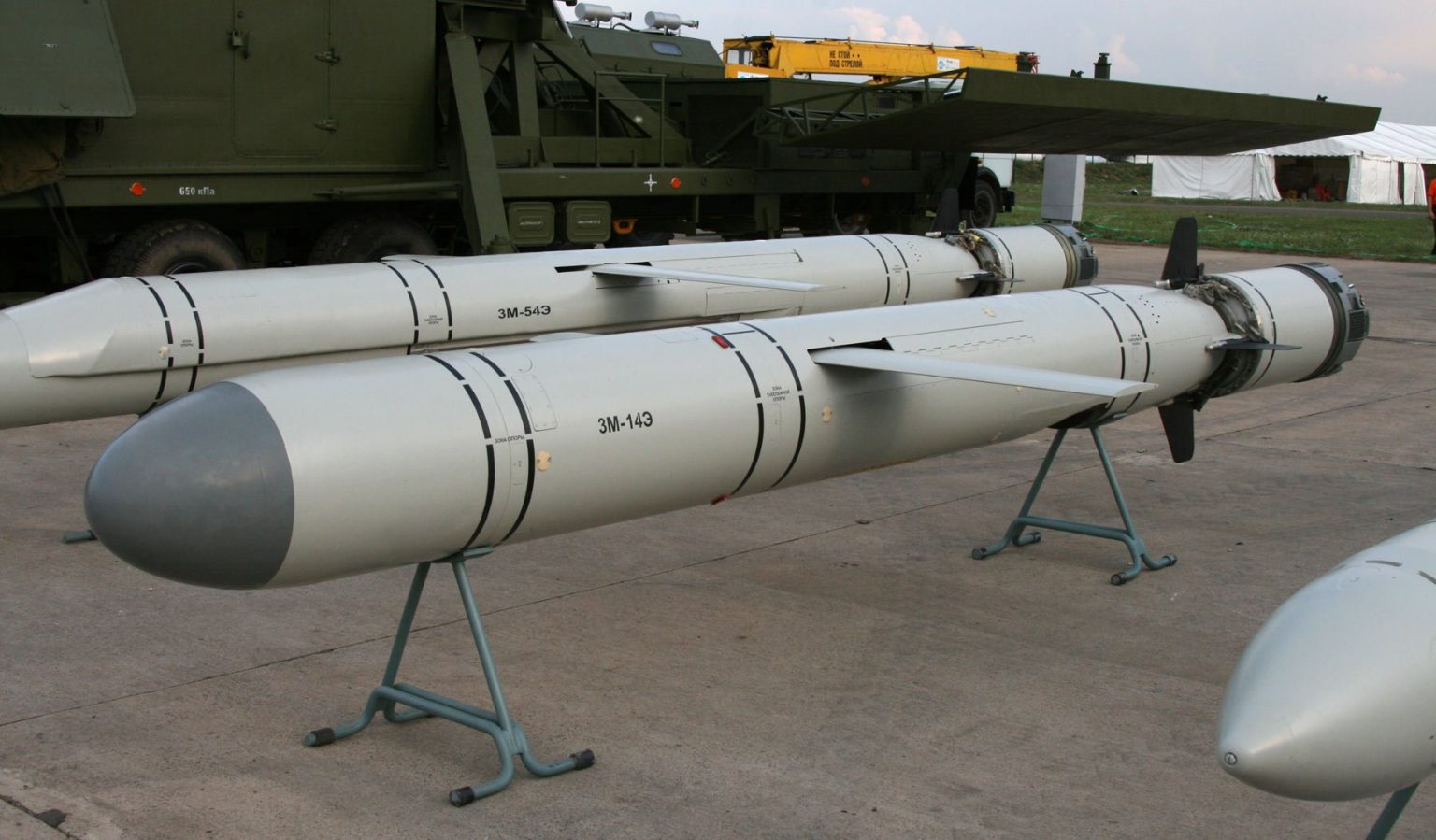
If this contract price is used solely as a unit for comparing scale, then:
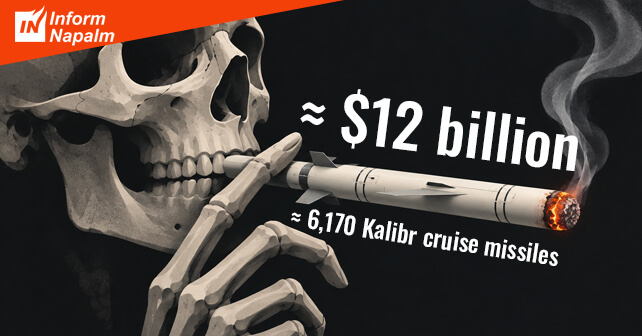
1.036 trillion rubles (approximately $12.02 billion) can buy roughly 6,170 Kalibr missiles.
This does not mean that Russia could physically produce 6,170 such missiles in a year, or that tobacco excise taxes are directly allocated to missile contracts. It is simply a way of illustrating the scale of the annual fiscal flow generated by the legal tobacco market in terms of Russian military spending.
Why a strike on one factory would not erase the “tobacco trillion”
It would be wrong to assume that destroying an individual facility automatically deprives the Russian budget of the relevant excise revenue. If consumers simply switch to products made by another legal producer, the state continues to collect the tax.
From a fiscal perspective, what matters is not an isolated disruption but a prolonged, systemic disruption of market operations. Such disruption can lead to increased spending on logistics, insurance, reserve warehouses and security, reduce corporate profitability, and shift some demand into the illicit sector, where the budget would lose excise and VAT revenue.
At the same time, Russia’s large domestic market has a significant capacity to adapt. Therefore, problems at one or several facilities do not mean the loss of the entire “tobacco trillion.”
Production is also relatively concentrated: JTI and PMI have six production facilities in Russia among them. InformNapalm deliberately does not provide the exact addresses or technical parameters of these facilities.
Tobacco at war: a mass-market product for the military
The tobacco market matters to Russia not only as a source of tax revenue. Cigarettes and other nicotine-containing products remain mainstay consumer goods among military personnel.
As of 1 August 2026, the authorized strength of the Russian Armed Forces is 2,426,130 personnel, including 1,535,000 military personnel. Separately, Vladimir Putin has claimed that the Russian force participating in the war against Ukraine numbers more than 700,000 personnel; this figure cannot be independently verified.
In 2026, a study of tobacco and nicotine product use among participants in the war against Ukraine was published in the Russian journal Public Health. The authors surveyed 1,135 participants in the war against Ukraine at offices of the state Defenders of the Fatherland Foundation. Some 67.2% reported using tobacco or nicotine products, while 60.2% were found to have a high level of nicotine dependence.
These figures cannot be mechanically extrapolated to the entire Russian invasion force, but they indicate the potential scale of demand. If the 67.2% figure is hypothetically applied to the claimed 700,000-strong force, it would amount to approximately 470,000 tobacco or nicotine consumers.
A Russian study of the economic affordability of cigarettes, published in 2026, estimated the elasticity of sales with respect to affordability at 0.36. When affordability deteriorates, part of consumers do not give up cigarettes but switch to cheaper brands and purchasing channels.
For a large military, this means that disruption of the normal operation of the legal market does not necessarily eliminate demand. Instead, it can shift demand toward cheaper products, informal channels and the illicit market.
Thus, tobacco is simultaneously a source of more than 1 trillion rubles in excise revenue for Russia and a mass-market consumer product, including among military personnel.
Conclusion
The strike on BAT alone does not prove that Russia is pursuing a dedicated campaign against the tobacco industry. However, it makes part of a series of strikes on tobacco assets and fits into the broader pattern of wartime risk spreading to Ukraine’s civilian production, retail and logistics.
For Russia, the tobacco sector is simultaneously a mass consumer market, a major source of tax revenue, and a significant everyday consumer product, including in the military environment.
Moscow can raise the economic cost of the war for Ukraine, but it cannot guarantee that it will remain one-sided.
Read more related material from InformNapalm
- Walking the Path of Fire: Twelve Years of InformNapalm’s War Against the Kremlin
- Ukrainian hackers uncover how Russian drone operators are using Belarus
- OKBMLeaks: classified documents from a Russian components manufacturer for Su-57 fighter and PAK DA Poslannik next-gen bomber
- CYBINT operation against the Gonets satellite system, dubbed “Russia’s equivalent of Starlink”
- Wildberries caught in the crossfire of drone strikes and cyber operations
- Ten years later: from OSINT detection to target destruction. Ukrainian Navy hits Russian Bastion missile system in temporarily occupied Crimea
- Hacktivists uncovered new classified documents from STC, Russian manufacturer of Orlan-10 drones
- CYBINT. Hacking Russian UAV manufacturer. Part 1: who assembles Geran-2?
- AlabugaLeaks. Part 2: Kaspersky Lab and neural networks for Russian military drones
- AlabugaLeaks. Part 3: Albatross, war, NVIDIA, Sony and Saito
- The Russian drone threat 2026–2027: Ukraine’s lessons for NATO
 This publication was prepared by Ashton Burson especially for readers of InformNapalm volunteer intelligence community. Distribution and reprint with reference to the source is welcome! (Creative Commons — Attribution 4.0 International — CC BY 4.0). Subscribe to InformNapalm social media pages.
 InformNapalm does not receive any financial support from any country’s government or large donors. Only community volunteers and our readers help us to maintain the site. You can also become one of the community volunteers or support InformNapalm with your donations.


No Responses to “The war economy: a strike on British American Tobacco and Russia’s “tobacco trillion””