


Both the state and Ukrainian society should pay more attention to the psychological rehabilitation of ATO soldiers. Cristian Jereghi, documentary film director and also a volunteer soldier in “Kievan Rus” battalion spoke in an interview with Radio Liberty. Cristian Jereghi is the Creative Producer of the “ATO Area: Returning” documentary, which aims to draw attention to the issue of social support for soldiers.
– “ATO Area: Returning” – a project for which you and your team are collecting money. The goal – to make social videos which will turn public attention to the issue of psychological and social rehabilitation of military personnel after their return to civilian life. How do you plan to do this? How do you make your video or social commercial really draw attention to this problem? In general, this question of the psychological rehabilitation of fighters, how much public attention is there on it?
“Since the fighters returned from Afghanistan, the problem has actively been supressed.”
– For the past 20 years Ukraine has not taken part in any military conflicts; I think everybody knows that. Since 1989, the year in which fighters returned from Afghanistan, the problem has actively been suppressed. There weren’t sufficient full scale rehabilitation programs. To this day, among those who returned from Afghanistan – and we know this problem because we talked a lot with them on Maidan – some never returned to a normal life, so far. Something was never fully healed, there are some incidents and conflicts with society. It is a very important issue, in our opinion, based on the international experience of countries with troops involved in armed conflict, which helped soldiers return and adapt to civilian life.
In order to do this, we have formed a team which includes foreign experts – specialists from America and Europe – in terms of Analytics, Anthropology and Psychology etc., to break down the problem into components. We are trying to figure out how the message was sent by the media and how it was delivered to both the soldiers and society. We joined forces with an initiative launched by Tatyana Rychkova, Assistant to the Minister of Defense, one of our most famous volunteers and one of the first volunteers’ movement leaders in Ukraine since Maidan.
– According to your observations, which countries have coped successfully with this challenge? Generally, can this problem be solved successfully?
– The problem is that, for example, there is no institution in Ukraine today that would have a clear understanding of the fact that a great deal of military personnel does have the post-traumatic stress disorder (what is popularly called the “Afghan syndrome”). The statistics and analysis in this area are very fragmented.
There is no single governmental program. If you pay attention to the experience of countries which have already come across this, we can see, for example, that in America, Britain and France, state and private initiatives have always supported the media campaigns underlining the consequences.
“Post-traumatic disorder is only part of the problem. There are the civilians who somehow got trapped in a war zone or were there.”
This is an issue not only for fighters. Post-traumatic disorder is only part of the general problem. For example, apart from the soldiers who are fighting, there are the civilians who somehow got trapped in a war zone or were there. Over time, the integration into society of all these people is no longer as simple as it looks.
This matter brakes down in even more parts. These are the fragments of a single, complex issue for which, we believe, we are not ready. All of us went to war unprepared for it. Now, during the war in Eastern Ukraine, we are doing our very best to mitigate those effects that arise after the military conflict.
– What is the target group of the video? Would that include all citizens or just those who make decisions at state level? Obviously, this requires some governmental program or direct governmental intervention in the matter.
– Ideally, there is no question that there should be a single state governmental program, rehabilitation centers for the psychological support of soldiers and their families as well as support programs there, in the combat areas. More specific, there should be direct instructions for the commanders on how to explain to the soldiers. Psychologists should be appointed to the units. This, again, is going on a circuit that exists and has been used successfully in the world.
“Abroad, after battle, they have something called <debriefing>, when either the commander or a psychologist examines the situation. Soldiers speak out and free themselves of it.”
In the Soviet Union there was no thought given to this. Treating the soldiers as expandable staff is the essence of the system which we are, in the long run, trying to eradicate. Abroad, for example, always after the battle there is such a thing as “debriefing”- when either the commander or a psychologist assigned to the unit examines the combat situation. The soldiers who took part in it, speak out and free themselves of it so that it doesn’t remain in the subconscious, as a horrible image. On the front you see terrible images. Somebody whom two minutes ago you embraced and talked to, who was for some time your best friend, you now see that person killed and another one, usually after shelling, suffering from terrible injuries. Doing things the right way, taking the correct preventive measures, it’s also part of the whole approach.
“The soldiers are reluctant, they say <why should I go?>. They get angry when someone talks to them about this. <I am not mentally ill>.”
In response to your question, I will sum it up: first, such media programs (we are not talking about journalism, because not everyone who comes back from there is willing to read the news or watch TV) – it is important to persuade the military, each of those who went through it, that there is nothing wrong in reaching out for help. Because it’s a taboo in this society. You call on a physician for help when you are injured, don’t you? But, say, after stress, if you have some kind of a program in your head which doesn’t allow you to communicate with people – here this issue is taboo. The soldiers are reluctant, they say “why should I go?”. They get angry when someone talks to them about this. “How come that I am going to a psychologists or psychiatrists? I am not mentally ill”. This is a taboo, a social taboo.
– Generally, do soldiers, let’s take for example the “Kievan Rus” battalion, get psychological help? Do the volunteer psychologists come directly to the front line to talk to the soldiers?
– They are definitely coming. But, again, this is not a single program, but a volunteers’ initiative. For example, the commander of “Kievan Rus” battalion, captain Andriy Yanchenko – he is one of the few commanders who really cares about this problem and really knows the issues. And even so, without governmental support- which he, of course, as a commander does have- his hands were tied when it came to helping the soldiers: when the fighting would begin, he would be a little bit preoccupied, to say the least.
“Most of them, thanks to this assistance, still feel better than those who did not receive it. You can see it in their eyes.”
If you are asking for a specific example of a battalion, at the “Kievan Rus” we had volunteer psychologists who provided some moral and psychological support to the soldiers. I must say that now, meeting with the guys who have been out of the Debaltsevo surrounding, most of them, for example, thanks to this assistance, still feel better than those who did not receive it. You can see it in their eyes. They are not closed up, they continue communicating, they don’t drown their grief in alcohol and, generally, are more adapted. They did not go through the stage of demoralization; now they are ready to return to the front – with only a small proportion of preventive measures being taken by the battalion commander and the psychologists who were at that time on the front with the soldiers.

– More on the current issues of social campaigns. For example, Veteran Vision Project, which is a private initiative. In the US, student Devin Mitchell travels the country and takes photographs of soldiers who have returned from the front. One of the problems highlighted by his photographs is a suicidal tendency amongst the veterans. Should a social campaign be that shocking in order to reach its goal?
– There are different ways in which to awaken consciousness in people in society. To generate a response, to raise this issue in the media sphere, make people talk about it. Yes, this is one of the ways, to make some shocking campaign. But, then again, you should take into account the specifics of the society, the specific mentality. For the average American, there are some techniques which are more comprehensible, familiar and will deliver the best message of a social product.
“Our society is in shock, as much as it could be.”
With Ukrainian society is important to take into account that this year was extremely tough: there was Maidan, there was a morally depressing Crimean defeat, the occupation of Crimea and after that a constant tension in the ATO area. Our society is in shock, as much as it could be. Now it is important to deliver some messages to that part of society which does not spend all its resources and efforts on those who are indifferent towards what is happening in the country. This is very important.
There is a group offering military psychological help at St. Michael’s Cathedral in Kiev. Perhaps this information will be useful for someone, it’s a free service. We asked the priest Father Sergei, who works in this group, about the specific problems faced by soldiers after returning to civilian life.
“The soldier comes home and often sees a different situation. The first feeling is of injustice, because they fought and gave their lives and now they feel purposeless – from the government and the people around.” (Priest Sergei)
Priest Sergei, deputy head of the Synodal Department of Charity and Social Ministry of the UOC -KP : “The soldier comes home and often sees a different situation. The first feeling is of injustice, because they fought and gave their lives, and now they feel purposeless – from the government and the people around. Some are proud of them but others do not seem to care. He feels contempt, this is a signs of post-traumatic stress disorder: feeling unneeded. To his family he seems a different person and he may feel they don’t love him the same way. He may become aggressive, he might cry in his sleep, he could become easily irritated, or abuse alcohol. Often, most soldiers do not realize this is happening within themselves. They see that something wrong happens around, but they don’t recognize their own shortcomings.”
– Do you see now that the government is moving in the right direction on this issue ? Or does it currently remain at the level of private initiative?
– In our country, as in other countries, private initiative helps to spread awareness within the cultural sphere. I would, of course, like to see interest among government officials. I would like to see a state structured program that would include both preventive measures and actual work with consequences.
“More than a hundred thousand people took part in the ATO.”
As for the previous comment, it’s absolutely true, that the problem is not limited to military personnel. In the near future we will face the problem again, the longer the fighting will go, the more it will grow, and gain momentum. After all, more than a hundred thousand people took part in the ATO. Additionally, about one third of the population is related or closely related to them.
“There will always be this psychological collision when a fighter returns to peaceful life: <Why should I fight for him?> The other one always has an inner excuse.”
Every time a fighter returns to peaceful life and sees a person who didn’t go to war, there will always be this psychological collision: “How come? Why should I fight for him?” The other one, who didn’t go to war, always has an inner excuse and will be showing that resistance. It is the routine interaction of people- a taxi driver, a security guard etc. Until time heals that, it’s going to be quite an issue and we are about to run into certain harsh and critical situations.

– Do veterans expect recognition for their heroism by citizens or do they expect from their government a form of social-economic support as a form of appreciation? And as to the citizens, what form should the recognition take?
“There is an active core of support, such as those who meet returnees at the train station. But then he or she faces domestic issues and a general misunderstanding.”
– Usually, people do not expect any kind of gratitude from the government. And even some military compensation for injury, for example, the majority of veterans see it as an unexpected surprise from the state – as well as any awards or recognition of combatants. The issue lies in gratitude from ordinary people, which is often not seen. Yes, there is an active core of support, such as those who meet returnees at the train station and bid farewell to those departing. But afterwards when the veteran is returning to the home-front he or she faces domestic issues a and general misunderstanding of their experience. This leads to serious conflicts.
– A colleague described a situation of being on the subway when a veteran came aboard and people were silent. Perhaps someone would like to say something but they do not know whether it is appropriate or not. Should people publicly express their gratitude or is it more expected to be left to family and friends and those who are in direct contact with veterans?
“When you are driving a military car and ordinary people on the street express their support, it helps.”
– Certainly among family a veteran can expect much talk about the war. And it’s much easier to talk with their colleagues, those who were there to discuss some issues than with civilian people. However, occasionally receiving friendly gestures while driving a car or the occasional honk, is appreciated. Especially, for example, in Zaporizhia, Dnipropetrovsk Oblast when you are driving a military car and ordinary people on the street express their support. This is very helpful, working to support one’s internal state. Unfortunately, in reality, when you go on the subway people try to look away because they either do not know what to say, or they have some inner conflict; perhaps feeling guilty by the presence of a man in uniform.
– Loss of faith in yourself, marginalization, alcoholism, suicide, development of clinical disease – are all possible consequences of post-traumatic syndrome if left untreated. Do you currently see such problems among your comrades?
“The man who was on the front has high demands for justice.”
– We’ve known such problems since Maidan-times. Only I would not formulate it as “marginalization”. The man who was on the front has high demands for justice. However, faced with sharp conflict at household level, it is not so much a matter of marginalization as it is an issue of struggling to adapt socially. After all, on the front-line problems were solved by force. This could result in incidents such as the military who returned from the front, ran into a group of aggressive people and threw a grenade at them. It is not marginalization but a mismatch of the level of danger and perception. That increases the distance between the military and society, to which he returned.
– Do soldiers receive any psychological training before they are deployed to the front? When you joined the volunteer battalion or before being sent East, did you have any psychologists working with you?
“Traditionally, you are trained to kill, but not prepared to live with the impact afterwards.”
– It should be noted that, for example, battalion “Kievan Rus” became one of the first, but not the very first. At that time there was no experience. It was a territorial defense battalion, half of whom were Maidan participants; and they did not receive psychological training. Unfortunately, yes, there have been destructive processes among those mobilized. This complicated the subsequent return to the battalion after the first rotation, as well as their problems with society. Traditionally, you are trained to kill, but not prepared to live with the impact afterwards. Psychologists were not working with the battalion back then. Now they are actively working which includes preventive work, particularly with those units being prepared for the most active fighting. Like airborne troops,those who actively stay on the front-line.
– Nevertheless, I would like to note that you are a Russian citizen. In February you asked President Poroshenko to grant you Ukrainian citizenship. In which stage is this process?
– It’s true. Currently the last formalities for legal procedure are almost completed. I hope that in the near future this issue will be resolved. Of course, because of my status, it’s hard. As long as you are not a citizen, you cannot deal with these issues formally, it is more on the level of a private initiative.
– You filmed documentaries about Maidan and also were in Crimea at the beginning of the occupation by Russia. How is it possible that you ended up in a volunteer battalion to fight for Ukraine?
“For some certain reasons I left Russia. I came here and defined Ukraine as my new home.”
– It’s very simple. I always have the same answer to this question, because there is no other option. For some certain reasons I left Russia. I came here and, relatively speaking, I defined for myself, Ukraine, Ukrainian borders, as my new home. Then came Maidan and these events. In Crimea I witnessed Russian annexation, in full violation of all agreements, both diplomatic and public. I could see for myself how it happened. I then talked with my friends from Russia and saw the results of Russian propaganda on society. I could see this dramatic change in society’s consciousness.
The occupation of the Crimea was relatively bloodless, except for a few cases. Then Russia began supporting separatism in the East …I went to Donbas, before and after the confrontations, as Slovyansk’s and Kramatorsk’s district centers and others were captured by Russian special forces operations. I spoke with locals, some of which, at that point, had not formed into militia groups but had established checkpoints. I witnessed this process. I saw there was lumpenization and marginalization. Simply speaking, as it has always been within Russian politics, to provoke instability among the very poor. Specifically, Russia supported and worked to incite those who had a very low standard of living.
When the first signs of paramilitary involvement and conflict with Russia appeared in the Donbas, it was a natural step for me to join the battalion. Moreover, to join under a commander with whom I had been with in Maidan from the beginning.
– Do you see an end to this war?
– A difficult question. It is difficult to guess the time and the date when the anti-terrorist operation in the Donbas will officially end as we are not prophets. Even the best analyst is unlikely to say exactly when it’s over.
“Our task now is to prepare for the consequences, to prevent an all-out crisis.”
Our task now is to prepare for the consequences. We are working to soften the possible fallout in order to prevent an all-out crisis in society in addition to the economic situation. To prevent a destructive processes that will lead to destabilization and might make Ukraine appear as too much of a liability for integration into the European community and foreign investors. In order to have investments in Ukraine we have to ensure our current heroes do not descend into becoming criminals as it happened in the 1990s, when veterans of military conflicts could not find means of adapting to society and without assistance through social programs, eventually turned to crime.
I should add that in the near future, at the end of the month will be a conference of NATO in Kiev, on issues of post-traumatic syndrome in the military. Just NATO countries are familiar with this problem. And I hope that we will establish cooperation.
Just recently we met with military attaches of various countries which have diplomatic missions here. We discussed with them the problems we are facing. Because even at non-political, non-economic level, the areas of philanthropy, art community, social initiatives of Europe, America, United Kingdom, and France are interested in seeing Ukraine stabilized. After this war subsides, Ukraine will remain a prospective partner for Europe.
Author: Olena Removska
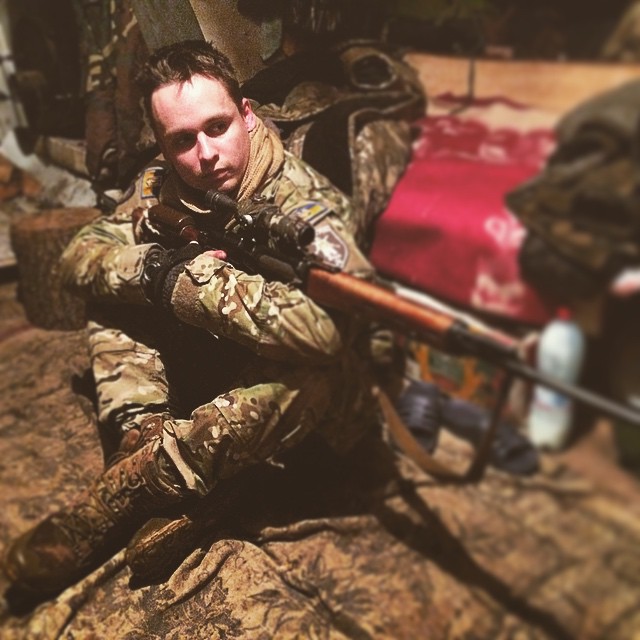
Photo: personal archives Cristian Jereghi


One Response to “A Soldier Back To Civilian Life Will Ask Himself: “Why Should I Fight For Him?””
05/17/2015
Un soldat de retour à la vie civile, se demandera: "Pourquoi devais-je me battre pour eux?" - InformNapalm.org (Français)[…] EN https://informnapalm.org/en/a-soldier-back-to-civilian-life-will-ask-himself-why-should-i-fight-for-… […]