

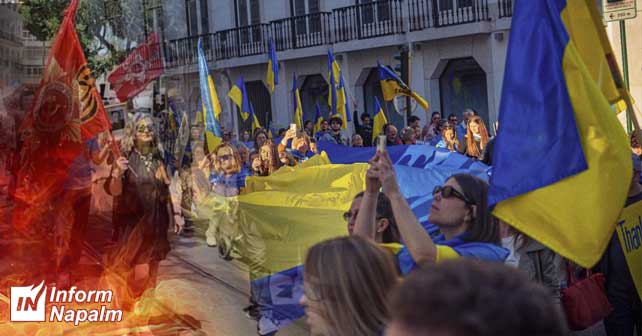
Since the beginning of the Russian Federation’s full-scale invasion of Ukraine in February 2022, Portugal’s political stance has generally remained stable and aligned with the broader Euro-Atlantic course. The condemnation of Russian aggression and support for Ukraine’s sovereignty have effectively become a broad consensus within Portugal’s institutional landscape, although noticeable differences remain among political parties and the public regarding the scale, forms, and limits of such support.
Public Opinion: Solidarity, but Within Clear Limits
Surveys conducted in Portugal indicate a consistent trend of support for Ukraine, particularly in the humanitarian sphere. Research by CESOP at the Catholic University of Lisbon shows that a clear majority of respondents are willing to welcome Ukrainian refugees and provide material assistance.
Overall, the data point to support for accepting refugees and supplying military equipment, but also to greater caution regarding increased public spending and a noticeable division of opinion over the possibility of direct military involvement.
This approach reflects a characteristic feature of Portuguese public opinion: a fundamental sense of solidarity with the suffering of the Ukrainian population, combined with caution about expanding the country’s involvement in the conflict and its financial and strategic consequences.

Screenshot from the website of the Catholic University of Lisbon.
Reasons for Supporting Ukraine
The prevailing support for Ukraine within Portuguese society can be explained by a number of interconnected factors.
Firstly, the war is widely perceived as a violation of international law and the sovereignty of an independent state. In this context, much of the Portuguese media has reinforced the image of Russia as an aggressor state within public discourse.
Secondly, Portugal’s membership of the European Union and NATO shapes perceptions of the conflict through the prism of collective European security and the West’s shared foreign policy position.
Thirdly, the humanitarian dimension has played an important role: the arrival of Ukrainian refugees in Portugal prompted a notable wave of public solidarity.
Finally, there are broader concerns and fears regarding the potential consequences of a Russian victory, particularly the risk of a shift in Europe’s security balance and the long-term destabilisation of the region.
Symbols, Historical Memory, and Political Perceptions
Portugal differs from several Eastern European countries in that it has neither banned Soviet symbols nor criminalised their use. This can partly be explained by the country’s historical trajectory following the Revolution of 25 April, as well as by the legal existence of the Communist Party within the democratic system. The Portuguese Communist Party has been represented in parliament for decades, while Portugal itself was never under Soviet occupation. This has significantly reduced the level of historical trauma associated with Soviet symbolism.
As a result, Soviet symbols and the historical imagery associated with them are perceived in Portugal in a less emotional and less contentious manner than in countries such as Poland, Latvia, or Lithuania, where the Soviet period occupies a very different place in historical experience and political memory.
“Immortal Regiment” and the Struggle of Narratives
The so-called “Immortal Regiment” (Russian: Bessmertny Polk), a march established in Russia to commemorate participants in the “Great Patriotic War”, has become a subject of controversy in many European countries since 2022.

From a historical perspective, it is worth recalling that the Second World War began in 1939 with the signing of the Molotov–Ribbentrop Pact and the joint invasion of Poland by Nazi Germany and the Soviet Union, followed by the partition of Polish territory between the two states. This issue remains subject to differing interpretations within Western and Russian historiography.
The debate has intensified in particular because of Russia’s use of historical memory for political purposes, most notably through the dominance of the narrative of the “Great Patriotic War”, a term used in Russia to describe the period from 1941 to 1945, rather than the broader concept of the Second World War. This reflects a specific historical construction of memory shaped within the Soviet and post-Soviet space.
In the Soviet, and later Russian, official version of history, the chronology of the war is centred on 1941, reflecting this particular framework of historical memory developed in the Soviet and post-Soviet context.
Thus, although the event is formally presented as a commemoration of participants in the Second World War, in the contemporary context it also functions as a symbolic reinforcement of the Russian state narrative.
It is also important to note that Ukraine and Belarus were among the territories most devastated during the Second World War, suffering enormous human losses and the large-scale destruction of social and infrastructure systems.
Ukraine lost an estimated 8 to 10 million people (both military personnel and civilians) although the exact figures remain unconfirmed. Its territory became one of the principal theatres of combat on the Eastern Front, leading to extensive destruction and long-term demographic consequences.
“Soft Power” and Historical Narratives: Commemorative Initiatives and Political Interpretations
In a number of European countries, including Portugal, such initiatives have, since 2022, become the subject of public debate in the context of Russia’s invasion of Ukraine, as these activities extend beyond a purely commemorative function and acquire a political dimension. This creates tension between the legitimate act of commemoration and the politicisation of history, where the past is used as an instrument of influence in a contemporary context.
From a historical perspective, it is worth recalling that the Second World War began in 1939 with the signing of the Molotov–Ribbentrop Pact and the joint invasion of Poland by Nazi Germany and the Soviet Union, as well as the division of its territory between the two states. This issue remains the subject of differing interpretations in Western and Russian historiography.
Debates have intensified, in particular due to Russia’s use of historical memory for political purposes, above all through the dominance of the narrative of the “Great Patriotic War”, a term used in Russia to denote the period 1941–1945 instead of the broader concept of the Second World War. This reflects a specific construction of historical memory shaped within the Soviet and post-Soviet sphere.
In the Soviet, and later Russian, official version of history, the chronology of the war is focused on 1941, which reflects a particular construction of historical memory formed within the Soviet and post-Soviet space.
Thus, although this event is formally presented as a commemoration of those who participated in the Second World War, in the contemporary context it serves the function of symbolically reinforcing the Russian state narrative.
In addition, it should be noted that Ukraine and Belarus were among the most severely devastated territories during the Second World War, suffering enormous human losses and extensive destruction of their social and infrastructure systems.
Ukraine is estimated to have lost approximately 8–10 million people (both military and civilian), although these figures are not definitively confirmed. Its territory became one of the main theatres of operations on the Eastern Front, resulting in large-scale destruction and long-term demographic consequences.
It is concerning that a significant portion of Russian communities abroad (as evidenced by activity on social media, where pro-Kremlin narratives are promoted), including in Portugal, may constitute a potential “fifth column”.
This is particularly noteworthy given that Russia is well aware of and adept at using Russian imperialist sentiments, as well as imperial and historical narratives, as instruments of influence not only within its own country but also in certain European societies.
These ideologemes constitute a powerful instrument of “soft power” and carry considerable risks, as Russians residing in Portugal are often unwilling to change their country or oppose Putin’s regime and its KGB-rooted legacy. Instead, and contrary to common sense, they seek to project it onto Portugal and other countries.
The world commemorates the victory over Nazism on 8 May, whereas Russia adheres to its own interpretation of history. At the same time, diplomatic statements continue, addressing not only Ukraine but also foreign diplomatic missions.
The following section was translated from Russian.

Screenshot of the official page of the Russian Embassy in Portugal.
Comment by the official spokesperson of the Russian Ministry of Foreign Affairs, Maria Zakharova:
…The Russian Ministry of Foreign Affairs strongly urges the authorities of your country / the leadership of your organisation to treat this statement with the utmost responsibility and to ensure the timely evacuation from the city of Kyiv of diplomatic and other mission personnel, as well as citizens, in connection with the inevitability of a retaliatory strike by the Armed Forces of the Russian Federation against Kyiv, including against decision-making centres…
We are well aware of the attitude of the collective Western minority towards 9 May: they systematically destroy the Soviet commemorative legacy, exhume the remains of Soviet soldiers, and rewrite and distort history…
All participants in the “Immortal Regiment” are also supporters of Russian aggression against Ukraine, as well as against other countries and former republics of the Soviet Union, such as Georgia, Moldova, Ichkeria, and others. They often use the letters “Z” and “V”, which have become symbols of support for the military offensive, as well as St George ribbons and Russian/Soviet military uniforms.
These participants have, each year, openly demonstrated support for Russia’s military aggression against Ukraine (which has been condemned by the European Union) and for the Kremlin regime’s policies more broadly. Vladimir Putin is subject to an arrest warrant issued by the International Criminal Court.
Unfortunately, another “Immortal Regiment” march is scheduled to take place on 10 May in central Lisbon, during which participants typically use the slogan “Ukrainians are Nazis.”
The contact details are clearly indicated in the photograph (from the “Новости Португалии” page, a mouthpiece for Kremlin narratives).
The contact details are clearly indicated in the photograph (from the “Новости Португалии” page [“News of Portugal”] a mouthpiece for Kremlin narratives).


Participants of the “Immortal Regiment” use the letters “Z” and “V”, St George ribbons, and Russian/Soviet military uniforms. They openly express support for Russian military policy and, in effect, for the military aggression against Ukraine.
Such events in Lisbon provoke controversy within society, are considered unacceptable, and are seen as posing a threat.
Final Remarks
The debate surrounding historical memory and the dissemination of Kremlin narratives demonstrates that war is not confined solely to the military sphere, but also continues in the political, cultural, and informational domains, where differing interpretations of the past continue to exert a significant influence on the present.
Portugal generally permits the holding of such events, given the characteristics of its democratic and legal system. At the legislative level, the use of certain flags associated with ongoing conflicts or pro-Russian messaging is not prohibited, although Soviet symbolism and contemporary Russian nationalist imagery are often associated with political support for the Kremlin and for individuals responsible for war crimes.
This is what is meant by democracy. However, the boundary between freedom of expression and the potential use of historical symbols for political purposes remains an open question. At the same time, it is worth considering that by allowing the dissemination of such ideas and narratives associated with the promotion of violence, war, and aggression, and by effectively providing a platform to aggressive supporters of the Kremlin, a country may face political and social uncertainty, instability, or even certain risks.
 Compiled specially for InformNapalm readership by Helena Sofia da Costa; the English and Portuguese translations were carried out by the author.
Distribution and reprint with reference to the source is welcome! (Creative Commons — Attribution 4.0 International — CC BY 4.0). Subscribe to InformNapalm social media pages.
 InformNapalm does not receive any financial support from any country’s government or large donors. Only community volunteers and our readers help us to maintain the site. You can also become one of the community volunteers or support InformNapalm with your donations.
InformNapalm social media pages: Facebook / Тwitter / Telegram/ Slate (Sl8).


No Responses to “Political Climate in Portugal in the Context of Russia’s War Against Ukraine: 2026 Overview”